CONSUMER TECHNOLOGY
Product-Led Growth Strategy: How to Build One That Scales




Written by Darkroom leardership
10 min read
September 21, 2026

Product-led growth is the most copied go-to-market model in software, and it's also the one teams most often get half right.
They build the free tier, polish the onboarding, and then wait for word of mouth to arrive. It rarely arrives fast enough.
This guide covers both halves. You'll get the definition, the reason most PLG strategies stall, what the IPO filings of Slack, Zoom, Figma, and others actually show, a seven-step build, and the metrics that tell you it's working.
Key takeaways: building a product-led growth strategy
Product-led growth lets the product do the selling, and it sits inside a wider growth marketing plan, not in place of one.
Most PLG strategies stall because the product converts demand but doesn't create it at scale.
Every company in our table that disclosed an advertising line at IPO was spending on ads, from 2.7% of revenue at Figma to 80.1% at monday.com.
A complete strategy has seven steps, and the paid distribution layer comes fourth, after the product proves it converts.
Track the funnel in order: activation, time to value, free-to-paid conversion, CAC payback, net revenue retention, and incremental lift.
What is product-led growth?
Product-led growth (PLG) is a go-to-market model where the product does the work a sales team would otherwise do. Users sign up, reach value on their own, and upgrade without talking to anyone.
It's one of several ways to build a go-to-market strategy, and it runs in four stages:
1. Sign-up. A free tier or trial removes the cost of trying the product.
2. Activation. The user reaches the moment the product proves its value.
3. Conversion. The user, or their team, starts paying.
4. Expansion. More seats, more usage, higher plans.
Most PLG companies use one of three entry models. Freemium keeps a free plan forever. A free trial gives full access for a fixed period. A reverse trial starts users on the paid plan, then drops them to free if they don't upgrade.
So what separates PLG from the model it replaced?
How is PLG different from sales-led growth?
The difference is who converts the customer. In sales-led growth, a sales team creates and closes the deal. In product-led growth, the product converts the user, and sales, if it exists at all, expands the account.
Product-led | Sales-led | Product-led with paid distribution | |
|---|---|---|---|
Who creates demand | Word of mouth and the product | Sales and marketing outreach | Paid media, loops and word of mouth |
What converts it | The product, self-serve | A salesperson | The product, self-serve |
What expands it | Usage, seats, upgrades | Account management | Usage, then sales for large accounts |
Where the cost sits | Product and onboarding | Sales headcount | Product, media and a small sales team |
Typical deal size | Small at first | Large | Small at first, growing |
Most PLG companies that reach scale end up in the third column. The product still converts, but something has to bring people to it.
Why do most PLG strategies stall?
They stall because the product converts demand but doesn't create it at scale.
A free tier waiting for word of mouth grows at the speed of its existing users. When each user brings in less than one new user, growth slows with every cycle instead of compounding.
Word of mouth works. It just needs a base someone has to seed first.
That's where most PLG guides stop short. They cover onboarding, pricing, and activation in depth, then treat acquisition as a side effect of a good product. For plg saas and consumer apps alike, that leaves the top of the funnel to chance.
The fix is a planned distribution layer. That usually means performance marketing that sends people to the free entry point, sized and measured as deliberately as the product itself.
Is that just theory? The companies held up as PLG examples answer that in their own filings.
What do product-led growth examples actually spend on marketing?
The best-known product-led growth examples all reported meaningful marketing spend when they went public. We read the IPO prospectuses of seven companies routinely cited as PLG proof, and checked their advertising lines in SEC filings.
Every one that disclosed an advertising line was spending on ads at IPO.
Company | Filing and period | Revenue ($M) | Sales and marketing ($M, % of revenue) | Advertising ($M, % of revenue) | What the filing says about growth |
|---|---|---|---|---|---|
Slack | S-1, fiscal year ended Jan 31, 2019 | 400.6 | 233.2 (58.2%) | 61.7 (15.4%) | "Our growth is largely due to word-of-mouth recommendations." |
Zoom | S-1, fiscal year ended Jan 31, 2019 | 330.5 | 185.8 (56.2%) | 36.1 (10.9%) | "Viral enthusiasm begins with our users as they experience our platform" |
Dropbox | S-1, 2017 | 1,106.8 | 314.0 (28.4%) | 80.1 (7.2%), reported as marketing and advertising | "Our 500 million registered users are our best salespeople." |
Atlassian | F-1, fiscal year ended Jun 30, 2015 | 319.5 | 68.0 (21.3%) | Not disclosed | "...we have been able to build our brand with relatively low sales and marketing costs." |
monday.com | F-1, 2020 | 161.1 | 191.4 (118.8%) | 129.1 (80.1%) | "...a self-serve funnel where virtually any user can sign up and immediately gain value" |
Figma | S-1, 2024 | 749.0 | 472.1 (63.0%; 35.4% excluding one-time stock compensation) | 19.9 (2.7%) | "...our marketing team utilizes organic and paid channels to drive awareness and usage" |
Duolingo | S-1, 2020 | 161.7 | 35.0 (21.6%) | 27.4 (16.9%) | "...primarily relying on word-of-mouth virality rather than paid user acquisition." |
Three readings stand out:
Slack credited word of mouth and still reported $61.7M of advertising. Both are true. The product converted the traffic the ads bought.
monday.com's advertising exceeded its revenue. In 2019, it reported $98.4M in advertising against $78.1M in revenue.
Duolingo's advertising was 78% of its sales and marketing expense in 2020, in the same prospectus that says it relied on virality rather than paid acquisition. By 2025, its advertising had reached $86.9M.
One caveat before you read too much into the numbers. The advertising line covers brand and performance spend together, and sales and marketing also includes salespeople. Figma's spend is mostly people, not ads. A sales team is bought demand, too.
How to build a PLG strategy, step by step
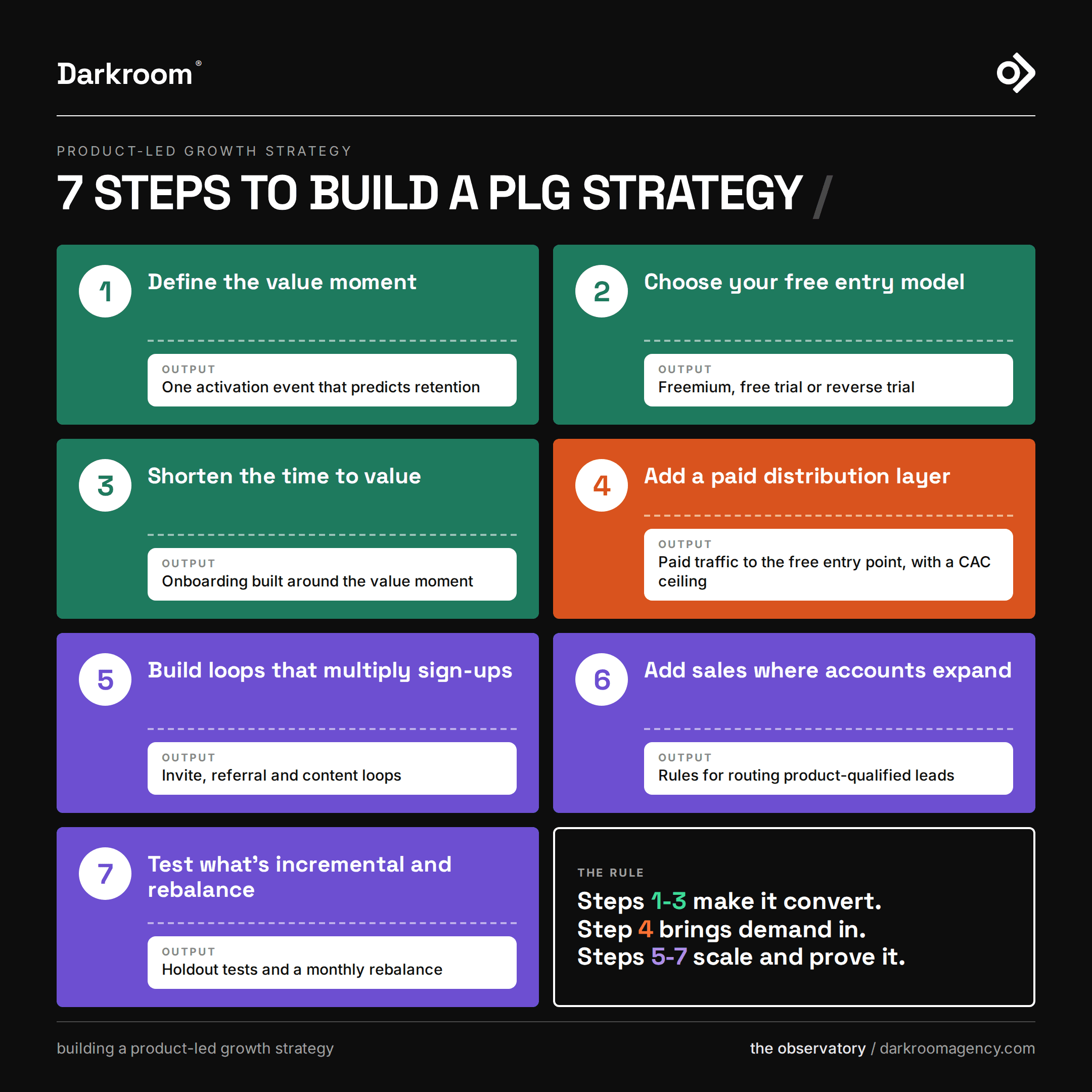
A product-led growth strategy is built in seven steps, and the order matters. Steps 1 to 3 make the product convert. Steps 4 to 7 bring people in and keep the system honest.
Step 1: Define the value moment
Pick the one action that predicts a user sticks around: a shared file, a first meeting, a completed lesson.
Find it by comparing users who stayed with users who churned. The action the retained group took, and the churned group didn't, is your value moment.
It becomes the activation event every later step is measured against.
Step 2: Choose your free entry model
Answer two questions. How long does it take a new user to reach the value moment? And how much does it cost you to serve a free user?
Short time to value and a low cost to serve suit freemium. A long time to value suits a trial, because users need a deadline to invest the effort. A reverse trial works when paid features create the value moment.
Step 3: Shorten the time to value
Build onboarding around the value moment, not around a product tour.
Use templates, prefilled examples, fewer form fields, and a first task that delivers the outcome. Then measure the median time from sign-up to value moment and cut it every sprint.
Step 4: Add a paid distribution layer
This is the step the filings prove, and most PLG guides skip.
Send paid traffic to the free entry point, not to a demo request. Pick channels where the ad can show the value moment in a few seconds. Set a paid CAC ceiling from your payback target, and set paid as a planned share of new sign-ups.
Write the plan down. A growth plan that sets paid against organic is how you stop paid spend from quietly becoming the strategy, or quietly disappearing from it.
Step 5: Build loops that multiply every sign-up
Paid seeds the loop. The loop lowers your blended acquisition cost.
Build three kinds. Collaboration loops: sharing a file or inviting a teammate brings in a new user. Referral loops: Dropbox's two-sided referral lifted sign-ups 60%. Content loops: templates and useful content that bring users back; the logic behind a content flywheel.
Step 6: Add sales where accounts expand
Define product-qualified leads by usage thresholds, such as seats added or a feature limit reached, and route those accounts to sales.
Figma's S-1 puts it plainly: "While our product-led, bottom-up adoption contributes to our growth, our direct sales motion helps us serve larger customers."
Step 7: Test what's incremental and rebalance
Run holdout or geo tests on paid, so you judge spend on the sign-ups it adds rather than the ones it claims. Incrementality testing is how you tell the two apart.
Then rebalance paid, loops, and sales every month against the metrics below.
Which PLG metrics should you track?
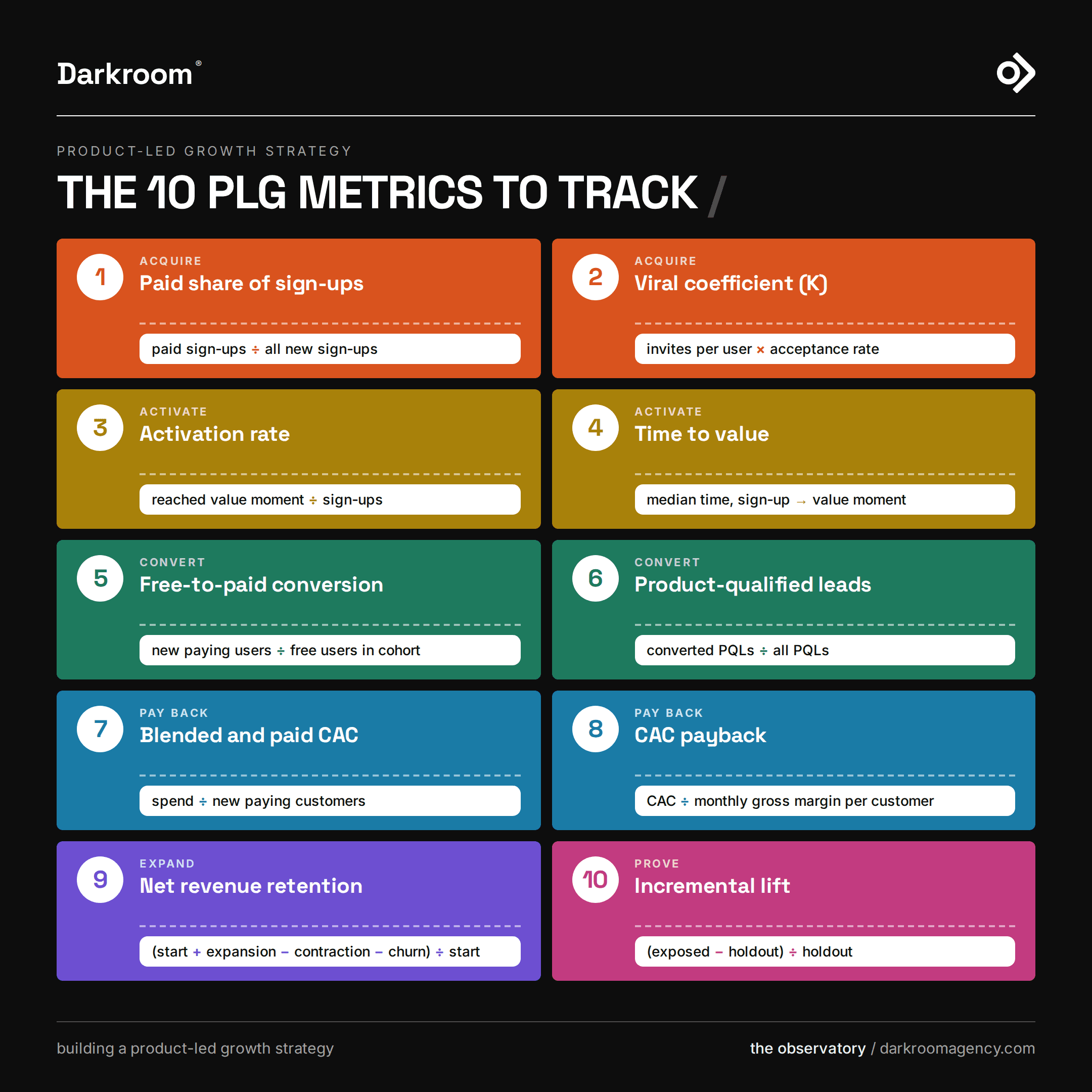
Track one or two metrics for each stage of the funnel, and read them in funnel order. Fix the first metric that breaks. More sign-ups can't repair a conversion problem, and a better onboarding flow can't fix a funnel nobody enters.
Paid share of new sign-ups
This shows how much of your growth you're buying. A falling share with total sign-ups holding means loops and word of mouth are taking over.
Formula: sign-ups from paid channels / all new sign-ups
Viral coefficient (K)
The viral coefficient measures how many new users each existing user brings in. Above 1, every user replaces themselves, and growth sustains itself. Below 1, loops lower your acquisition cost but can't carry growth alone.
Formula: invites sent per user x invite acceptance rate
Activation rate
Activation rate tells you whether onboarding works. Measure it by cohort, so an onboarding change shows up in the users who saw it.
Formula: users who reach the value moment / new sign-ups in the same cohort
Time to value
Time to value is how long it takes a new user to reach the value moment. Use the median, because a few slow users distort an average. Step 3 exists to cut it.
Formula: median time from sign-up to the value moment
Free-to-paid conversion
This tells you whether your entry model and pricing work. Track paid-sourced and organic users separately, so you can see whether paid traffic converts like organic traffic.
Formula: new paying users / free users or trial starts in the same cohort
Product-qualified leads
A product-qualified lead (PQL) is an account whose usage predicts it will buy or expand: seats added, a feature limit reached, several teams active. It's where sales time should go.
Formula: PQL conversion rate = PQLs that become paying or expanded accounts / all PQLs
Blended and paid CAC
Customer acquisition cost (CAC) shows what growth costs. Blended CAC covers everything; paid CAC isolates the paid layer, so you can see whether step 4 pays for itself.
Formulas: blended CAC = sales and marketing spend / new paying customers · paid CAC = paid media spend / new paying customers from paid channels
CAC payback
CAC payback is how many months it takes a new customer to repay what you spent to acquire them. It's the number that sets your paid CAC ceiling in step 4.
Formula: CAC / monthly gross margin per new customer
Net revenue retention
Net revenue retention (NRR) shows whether existing customers grow. It's the core compounding metric in PLG. Above 100% means revenue from existing customers grows even with zero new sign-ups.
Formula: (starting recurring revenue + expansion - contraction - churn) / starting recurring revenue
Incremental lift
Incremental lift tells you whether paid spend adds sign-ups or just claims ones that would have arrived anyway. Measure it with a holdout or geo test, as in step 7.
Formula: (conversions in exposed group - conversions in holdout group) / conversions in holdout group
What are the benefits of a PLG model?
Product-led growth delivers five benefits, each with a condition attached:
1. A lower cost to convert. Self-serve replaces sales touches on small accounts. Atlassian's F-1 credits word of mouth with building its brand at "relatively low sales and marketing costs." Condition: users can adopt the product alone.
2. Faster product feedback. Usage data shows you what works within days, not quarters. Condition: you've instrumented the value moment.
3. Expansion revenue. Accounts that start small grow into seats and higher plans. Condition: pricing rewards usage.
4. More efficient paid media. When more clicks convert, every paid dollar buys more customers. Condition: steps 1 to 3 come before step 4.
5. A focused sales team. Salespeople only work accounts already using the product. Condition: clear product-qualified lead rules.
The limits are just as clear. PLG needs a product people can adopt on their own, and it needs a plan to bring them to it.
Get your growth plan written down
A product that converts is half a strategy. The other half is a written plan for how people reach it, how much you'll pay, and how you'll prove the spend is working.
That's the plan Darkroom's growth strategy team builds. A dedicated senior strategist owns it, and it runs from a Flight Plan: one live document connecting your goals, media investment, pacing and budget opportunities, so paid and organic are set against each other on purpose.
Talk to Darkroom's growth strategy team
Frequently asked questions
What is product-led growth?
Product-led growth is a go-to-market model where the product does the work a sales team would otherwise do: users sign up through a free tier or trial, reach value on their own and upgrade without talking to anyone. It lowers the cost of converting demand, but it still needs a plan for bringing that demand in.
How do you build a product-led growth strategy?
Define the value moment that predicts retention, choose a free entry model, cut the time it takes a new user to reach that moment, add a paid distribution layer that sends traffic to the free entry point, build invite and referral loops, route high-usage accounts to sales, and test whether paid spend is incremental.
What metrics should you track for product-led growth?
Track activation rate, time to value, free-to-paid conversion, product-qualified leads, paid share of new sign-ups, blended and paid customer acquisition cost, CAC payback, net revenue retention, and the viral coefficient. Read them in funnel order: a conversion problem cannot be fixed with more sign-ups.
What is the difference between product-led and sales-led growth?
In sales-led growth, a sales team creates and closes the opportunity. In product-led growth the product converts the user and sales, if any, expands the account. Both still need demand to arrive, which is why most PLG companies add paid distribution and, later, a sales team for larger customers.
Is product-led growth free growth?
No. Every PLG company in this article that disclosed an advertising line at IPO was spending on ads. Slack reported $61.7 million in fiscal 2019, Zoom $36.1 million and monday.com $129.1 million in 2020. The product made that spend efficient by converting the traffic it bought.
Does product-led growth work for consumer apps?
Yes, and consumer apps show the paid layer clearly. Duolingo's S-1 says it grew mainly through word of mouth rather than paid user acquisition, yet it reported $27.4 million of advertising in 2020, 78% of its sales and marketing expense, rising to $86.9 million in 2025.