When Paid, Organic and Creator Become One with Wispr Flow, Manychat & Motion App
Jul 28, 2026
key takeaways
Paid, Organic, and Creator Are Collapsing Into One System
The old walls between paid ads, organic social, and creator content are gone — brands now grow all three in tandem and watch them lift each other. ManyChat aims to put 4 of every 10 paid impressions behind a creator, and Whisper Flow scaled a B2C-SaaS product by importing the e-commerce creator playbook wholesale.
Meta's "Andromeda" Forces Persona-Level Creative Volume
Dara Denny flagged the biggest shift in performance marketing: where the goal used to be one maximally scalable creative, Meta's Andromeda algorithm now hyper-personalizes delivery—so brands must build a unique content ecosystem per persona, multiplying creative needs several times over. Volume is non-negotiable, but only distinct, genuinely unique creative gets picked up.
Creators Are the Growth Engine — Selection, Authenticity, and Incentives Decide It
The panel agreed creator selection is the single biggest lever, that creators must actually use the product to sell it credibly, and that open-ended briefs preserve the authentic, differentiated voice the algorithm rewards. Whisper Flow's always-on "creative factory" runs ~200 creators paid on a percentage of ad spend—because, as Dara put it, bringing only statics and mashups to your ad account is "a butter knife to a gunfight."
The "Marketing Engineer" and the AI-Automated Ad Account
The most future-ready teams hire systems thinkers who deconstruct each workflow step and apply AI to it. Whisper Flow automated its entire account — tagging, naming, and moving ads through exploration → iteration → scaling—via Claude Code plus the Motion and ad-manager integrations, so one media buyer runs a multimillion-dollar account with nothing published manually. The prerequisite is obsessive documentation (an "OS" of creators, ad types, and references) that lets a smaller team ship far more.
transcript
Speaker 1 (00:00): There's a limiting belief that we hear a lot where it's like, oh, my brand could never make viral organic content. I'm an attorney. I'm like, I could give you viral ideas in two seconds. All right, so we are going to hop into this next panel here and we are going to talk about, you know, actually, I'm going to start with a personal anecdote. So Ashwin and I, Ashwin, who was on the panel here prior, we were at an event. When we first came in, we were at a TikTok event. Anyone know TikTok show of hands?
Speaker 2 (00:31): No.
Speaker 1 (00:31): I'm joking.
Speaker 3 (00:31): All right.
Speaker 1 (00:32): We were talking to. There's no creators of the TikTok event besides Ashwin and I, and we are talking to a series of CMOs and executives who had obviously never met a creator before. Like, never. They're like, oh, like, what is that like? And like, making content and doing whatever. And I think that is. There's all these themes. Everyone talks about AI, they talk about taste, they, et cetera. But I was like, man, not only do they not, you know, know creators, they don't really consume content in that way. And the reason that that's a problem and why I want to highlight it going into this panel is that the now, this year, with more new people than ever, more creators, more than ever, is that there's just a gap even in the events.
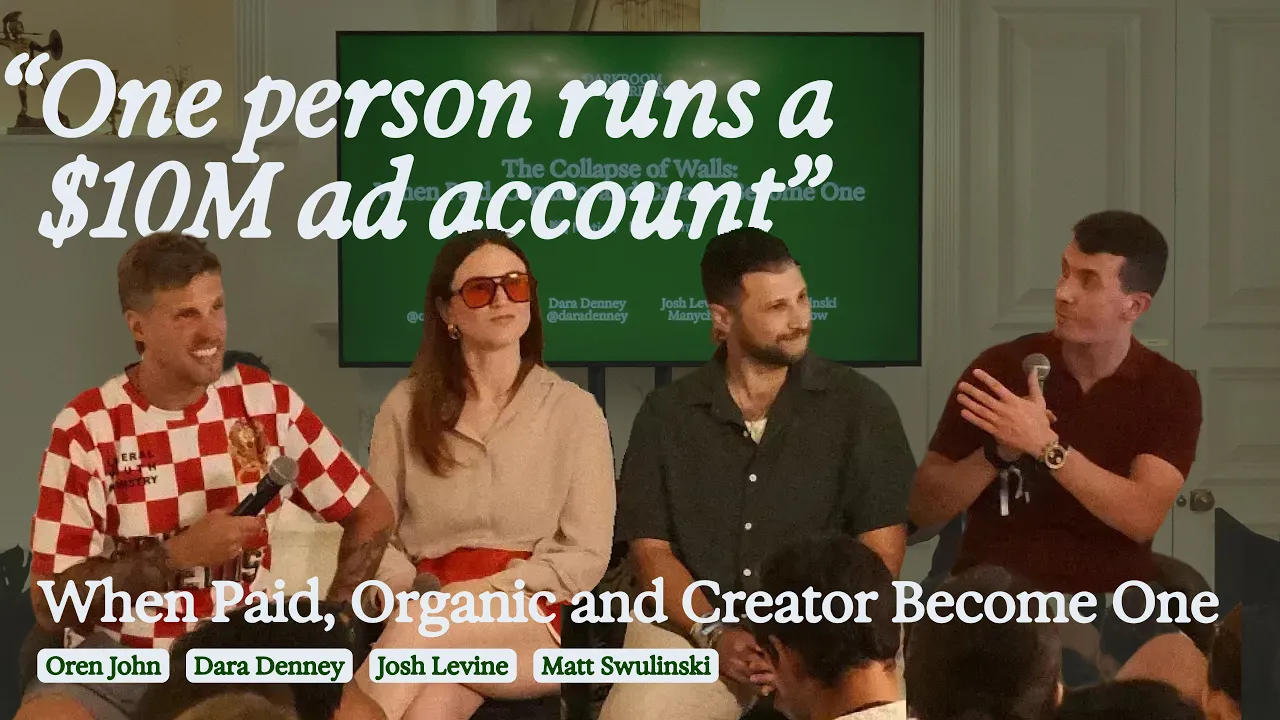
Speaker 1 (01:07): We have all these. Like, everyone here is in modern media, new agencies, younger folks, creators, and then there is literally like an equivalent room, I guarantee, where everyone's 50 to 65 in, like, a different place, and they're talking about alternative subjects. And really the issue is that they're kind of becoming one, and one group realizes that. I feel like we realize that. And we'll talk about tactics here across a wide swath of brands to get into it. And one kind of does not. They have an inkling of what's coming, but don't quite understand it. And it's our job to kind of interpret that. So today we're going to talk about the collapse of walls when paid organic and creator become one. We're doing this with our friends at Motion.
Speaker 1 (01:39): We'll give an intro for here in a minute, and then just to give some background, I want to pass it to each of the guests because I feel like when you see CPG Garden or you see people talk about stuff like creator, it's always like, oh, yeah, but that's for, like, a cool soda. But that's not how this works. So we have people From Whisper Flow, which I use every day. Raise your hands if you use Whisper Flow.
Speaker 3 (01:56): Hell yeah.
Speaker 1 (01:57): All right. Yeah. Shout out the gods. You know, I mean. All right. And then number two, if you use ManyChat. Who uses ManyChat on my career as I. Yeah, many chat. Life changer. Yeah. All right. I'm not going to go too deep into it. And then Dara, every seen Dara's content knows what I'm talking about.
Speaker 3 (02:12): Hi.
Speaker 1 (02:12): I will let you all give a proper intro yourselves. I just wanted to get a little pulse check. Dara, you want to give a background?
Speaker 2 (02:17): Yeah, absolutely. Thank you so much for having me. So my name is Dara Denny and I always like to tell people that I have three jobs right now. Number one, I own a really small creative strategy firm. We do performance creative for eight and nine figure brands. And I'm also a full time content creator. I make content for performance marketers. So actually is. Are there any performance marketers in the room? A few hands. Excellent.
Speaker 1 (02:40): Have you checked ads Manager since you've been here?
Speaker 2 (02:42): Yeah, yeah, definitely. Right. So and then number three, I'm also chief evangelist at Motion, which is a creative analytics software tool that I love. They were actually my first brand deal five years ago. So it's just really cool to be able to see that long term partnership grow.
Speaker 4 (02:59): Yeah. And thank you for having me as well. My name is Josh Levine. I lead creative strategy at ManyChat. For those that don't know ManyChat, we're the number one Instagram automation platform. So comment this word and we'll send you a link. That's us. And I'm also a content creator as well, doing brand and creative marketing content.
Speaker 3 (03:17): Hey guys. Last but not least, I'm Matt Zelensky. I'm head of growth at Whisper Flow. So I actually skinned my teeth in agency and E comm and now I do, let's say this creator and performance model at a hypergrowth B2C SaaS. So I saw a lot of hands. But for people that don't know what Whisper Flow is, it takes what you say instead of typing, throws that into any text box on your phone, on your computer and yeah, excited to be here.
Speaker 1 (03:40): All right, so I'm going to throw a little scenario out there. If you make any ads or you do any creative nowadays, you brief stuff, you put all these things into the account, you have to make up all these ideas, you have to do all this creative volume, you're coming up with new ads, whether you're making software, whether you're A strategist, whether you're a creator, you're doing it constantly. And something that, that we share in common, obviously you're a chief evangelist, but we all use this software called Motion, who is the partner for this panel organically, because we have to make tons and tons of not just the briefs and the creative, but how we understand it, how we interpret it, how we track competition and work through others.
Speaker 1 (04:10): And that seemed like the perfect person or brand to work with around this because this is like the issue, right? We're all using these kind of sophisticated workflows. All this is changing super fast. Explaining it to bosses, to brands becomes really complicated. Easier if your brand is on the cutting edge, harder if your brand is more. It's more antiquated or you're dealing with older process. And so I think what we're going to talk through here today is a bit of understanding of the past and then real strategies that brands are using to kind of bridge their way to the future. So I want to start with you about how has advertising changed online performance advertising, let's say 24 months ago to today?
Speaker 2 (04:44): Okay. So I've worked in performance marketing for the last 10 years when you could just throw a simple image of a product and have insane roas. My, oh my, how the times have changed. And I'd say the biggest thing that has really changed over the last 24 years is the introduction of Meta's new algorithm called Andromeda. Probably their best PR campaign to date to get people to talk about like a new product update. But how this really changed my workflow as a creative strategist is this. So I used to do creative strategy for nuts.com and Laura Geller. And when I was developing content for them, my mentor would tell me, hey, you need to not develop content for specific Personas. So for nuts.com for example, we worked like our Personas were grandparents, teachers and moms.
Speaker 2 (05:33): And my mentor was like, don't create content for teachers. Now that's the complete opposite because like back then, it was really about developing the most scalable creative possible. This was the language that was used to me. And now the biggest thing that has changed with Andromeda is this hyper personalization of the delivery of content. So it's actually proposed a very unique challenge to creative strategists because now we have to spin up unique content ecosystems for each of our Personas. So overnight, what we had to do almost tripled depending on the Personas, because we have to make unique content for each individual now.
Speaker 1 (06:10): And so I Think what we've seen is these worlds basically merge. So you have your organic strategy, you have on your organic account, you have creators and influencers that you work with. You have your ads that you run at the same time. And you're doing all this in tandem and you're trying to grow them as much as they can. You start to realize when you run the analytics that you actually see improvement as all of them increase. And I will say so ManyChat. I'm gonna ask Josh a question here in a second. I get. I've done brand deals for them. I promoted ManyChat. It's a software that I use all the time. Most marketing creators in here have probably done or will be doing a ManyChat deal.
Speaker 1 (06:39): They are very good at surface area covering anyone who talks about the subject. I've also been served ManyChat ads, gotten the promoted post because I'm also in the target demographic. I feel like there's been a really holistic strategy around how you've put that together as a software platform. So I'd love for you to just discuss a bit of. Okay, what is the philosophy behind that? How do you about that as a brand doing this right now?
Speaker 4 (06:58): Yeah. So we're a B2B brand, right? Like anyone that monetizes on social is a business that can use our software. So we're a B2B brand that acts like a B2C software. Something that we've done that is very unique to ManyChat is we value impressions. It's a lost KPI that people don't actually track or care about anymore. Everything is cac, everything is conversion rates, but impressions matter. And impressions are different across different channels. And I can tell you that because I imagine that the impression that you're getting of all of us here is very different than the impression that you get on organic social media. Right. That's a very different impression. And that's the same thing across every other channel that we do, right? Events, influencer marketing, email marketing.
Speaker 4 (07:37): So the way that we run all of our marketing is integrated, right? We track impressions, we try to track the quality of each impression as well. And the best way that we can create high quality impressions is by working with creators. They are people that have strong, unique voices. And to Dara's point, Andromeda has driven the need for volume more than ever. We are testing more than ever. We need unique voices on social to target different messages, different audiences. Because when we are a platform that is looking to monetize on social, on social media, that can be a tremendous amount of different people. There are fashion bloggers, there are AI creators, and the through line that they have is that they're trying to make money from social media, they're trying to be businesses.
Speaker 4 (08:19): And we need people that can communicate, that understand their audience and can do that at scale. And the only way we can do that is by working with creators and something that we're intentionally trying to do. It's probably going to increase soon, but I'm trying to put four out of every 10 impressions on paid behind a creator, just wherever we are. And that's trying to scale as well. And that's because we really believe in what all of you guys are doing on social media platforms.
Speaker 1 (08:44): And so you are in an interesting circumstance where for any of you who know Whisper Flow, you probably had someone really excitedly tell you about it. Be like, this thing changed my life.
Speaker 3 (08:52): Right.
Speaker 1 (08:52): So you have a brand that is in a boring category. People talk about voice that's disruptive and exciting, that also has this big organic and word of mouth. How do you approach growth? How do you accelerate those things? We'd love to learn more about the strategy.
Speaker 3 (09:05): Yeah. I mean, at the end of the day, when you're looking at SaaS, specifically a product and voice, there's a lot of competition that has come out. And for us it's been applying that E Comm playbook of a lot of creative strategy, a lot of creators, a lot of partnerships that kind of build that credibility where when you're explaining what we do, it's also a little difficult. Right. Like if you have a product, an ecom, you show it, you say what it does, and then you can sell it. But for you use your voice, it turns into text. It's a lot harder to frame through a creator lens.
Speaker 3 (09:36): So there's, there's a lot more work to actually, actually like White Glove and work with creators to actually explain to different pain points of, you know, let's say you're actually a creator making scripts. That's a completely different use case than a founder that is responding to emails. Right. And we unfortunately are a product that can be used by everyone, which also means it's really hard to create at volume a lot of content that speaks to each of those individual people. And that's also why like we've, you know, we, we service millions of Mao right now. And that's been over, you know, a year and a half of almost two years of growth, which is insane, right, to think about, like any company is growing that fast before. But that's on the back of dedicated creative and partnerships that we've done.
Speaker 3 (10:19): And I think without also AI and kind of these analytics systems, it would have been really, really hard to understand what is actually working, what's driving conversion. And it's also like for a lot of people that don't know this, I wish there was a triple whale for SaaS. There's not right conversion tracking. Mmm. All of this is entirely technical and manual and I had to spin that up from zero being marketing employee one at Whisper and like I had to do everything that I love in E Comm, bring that into SaaS. And that's also like the best SaaS businesses function like high growth E Comm brands and that's like where you'll see the best growth is the companies that apply that strategy.
Speaker 1 (10:58): And I think there's a limiting belief that we hear a lot where it's like, oh my brand could never make viral organic content. I'm an attorney, I'm like, I could give you viral ideas in two seconds.
Speaker 3 (11:06): All right.
Speaker 1 (11:06): And then you look at. All right, we, we can't run that playbook. That's for D2C brands, that's for X or Y. This is a playbook across basically any non regulated industry can kind of look at the same thing. It's just taking that leap of faith. And what I love about is being able to point to examples like that. Well, yeah, look, this is a voice product that you know, with AI, like AI tech that can leverage that. Claude, I think being an excellent example of an enterprise application. But I want to double tap on your comment real quick and just give people some perspective. How many creators, for instance do you work with in a given month?
Speaker 1 (11:36): Or if you want to highlight, if you want to tell right now, I want to give a year into your growth, I'd be curious, like what does that scale look like? And then like where do you find them? How do you choose?
Speaker 3 (11:43): Yeah, so we have a like very nimble team. So I actually was the single person doing all strategy and all execution up until December of the past year, managing a 6 to $10 million budget a month entirely alone. But at the end of the day for us, we actually are using Tribe, which maybe some of you know, shout out Tribe.
Speaker 1 (12:06): Yeah.
Speaker 3 (12:06): So I mean it's an E Comm creator platform, but we essentially, using Tribe and relationships with creators, have built a creator program that is 200 creators strong. We have a Discord, we have three meetings a week. We have, you know, a creator manager essentially that works super closely with them. And we pay on percentage of ad spend because also because of the way that we work our KPIs and our conversions are different than purchase and ROAS. So if an ad deserves spend it will get spent from our side. And you know we have a multimillion dollar a month meta budget. So a lot of our creators are making a lot, right. Creating good ads and that like that incentive structure we have seen. Like we have 200 to you know, let's say 250 right now.
Speaker 3 (12:47): Active creators and they create between three and 10 videos each a week. Some we spend again, some we don't. But like we have an always on kind of creative engine that like we call it our creative factory. Which I can talk on later too.
Speaker 1 (13:01): Yeah, well I want to call out to just make sure people know there's like four tribes people. You guys are terrible at naming startups. Not you guys. Why the industry in general. And so the one he's talking about is it's Squids tribe. Long story if you don't know the lore. But it's about ecom creators for Instagram. And so basically you go in there and you can find list of creators, you can DM people and then it will automatically set up if an ad in your ad account works. It's not just for like raw ugc. You put it in the ad account and it gives them a percent based on what scales. And so it's interesting. I actually haven't heard of a SaaS product using that yet.
Speaker 1 (13:31): But just again shows you all these tools that are happening. They're just trying to say let's replicate a TikTok shot model on Instagram. But these are like the kind of things where if you are on that platform now Astron and I talk about this a bunch because we both use it him more than I. But like if you are doing that now you are ahead of the game. And so that's the kind of stuff we want to highlight here is like if your brand is working on any of this and you're running creator under that you can get ahead of that's here on the bell curve. And so we want you to act on that. Well and related to this like UGC has changed as well.
Speaker 1 (13:57): We're now I've seen a lot of noted yappers out here. People just talk on camera in their car and or just talk on camera for video. There's so many creators working out there. How has UGC changed? What makes good UGC now?
Speaker 2 (14:10): Yeah, I mean I think it really all comes down to being able to really connect and have empathy with your audience. Like people that can show up and be vulnerable. I actually, like, recently read this book that's called how to Tell a Story by the Moth. If any of you listen to that podcast. And my biggest takeaway is that it's impossible to not be able to tell a good story as long as you show up and you're vulnerable. And I actually think about, like, when I do things like this, like public speaking doesn't come supernaturally to me. And as long as I can, like, show up and be vulnerable and as long as I can show up and be vulnerable in my content that tends to like, translate really well.
Speaker 1 (14:45): You're doing great.
Speaker 2 (14:46): Thank you. Ask me after my wine after this, please.
Speaker 1 (14:51): And so I'd be curious, if you were working on UGC for a brand right now, how would you. And you're trying to brief it or start it, where would you begin? What are some ideas? How do you even start that process of being like, oh God, I have these creators, I need them to yap about this. Do I give them full creative reign? Do I make them a brief, like from step one, let's dive into it.
Speaker 2 (15:07): From like the strategic point of view or we're trying to like, we're trying to get out to certain Personas that our audience has. So we're first making sure that we are, we are connecting with the creators that are actually speaking to that target audience or who embody that target audience. So it all starts from creator selection. I always tell my team that the number one important like thing that you need to do when developing a creator program is how you select those creators. Because I think that there's such a nuance to it and like, I'm not an amazing systems thinker because I'm also a creator. It's just like I feel like people have this like je ne sais quoi. So I'm actually very curious to hear how you guys do it.
Speaker 2 (15:46): And another question that I have for both ManyChat and Whisper is if you guys have started incorporating internal content creators. Because I'm actually going through this process of starting my own brands next year and instead of, you know, going through the process of hiring a creative stuff strategists and like building a huge creator program initially, I'm actually starting from like founder based content and hiring internal content creators or content like creators on retainer. So I'm curious how you approach that.
Speaker 4 (16:14): Yeah, I mean, I think it's something we haven't done enough but should, because it's an extension of founder led content. Right. It's a trusted voice that can speak to your product that doesn't need to speak to you know how to just be engaging and entertaining on the platform, especially if you're running an ad. But for us, and to your point around ugc, we do it in two ways, right? Because we're a very specific and technical product. There are creators that can speak to how to use ManyChat, and then there are creators that can't. And the ones that can speak to how to use ManyChat, we give them a tremendous amount of creative freedom. The ones that can't are paid actors. Right. That's essentially what they are.
Speaker 4 (16:47): And like, let's be realistic about it, UGC creators are paid actors a lot of the time if they don't use the product or if they're just getting onboarded to it. And so we will work with them and we'll work to figure out what their creative vision is. But I'm not against scripting things for them, not only because it makes it more comfortable for them, but also because we know we're going to get a strong piece of content in return. So I think the distinction really comes down to how well someone knows your product.
Speaker 1 (17:12): And I do think we're going to see the rise of creators being like, man, I should do like improv or learn acting is actually going to have to end up being a thing because it's one of these. You don't realize until you're actually in it where you're like, oh, well, I want to be able to play that character. I want to have more of a presence. I want to be able to do X and Y. So if anyone wants to join me for some improv in the back after, we'll be. But you also, you have an interesting framework. You have a pillar system. You apply to all of your marketing. You want to explain that?
Speaker 4 (17:32): Yeah. So this builds on what we were talking about earlier with impressions, Right. And impression quality. When you're looking at a piece of content, whether it's on organic or on paid, you're only trying to do two things, which is to actually capture someone's attention and then get them to take an action. Right. So if it's unpaid, the action you're taking could be buying a product or, you know, joining a lead magnet or, you know, submitting for a demo. And on organic social, it's. Can you share this post with someone? Can you comment? Right. So inherently it's the same and our Pillar system recognizes that, that you can't try to convince someone of multiple things at once and your entire marketing ecosystem works in tandem.
Speaker 4 (18:09): So you're trying to get someone to either like your brand, right? Do they have affinity for what you're doing to prefer your brand compared to others? Do they prefer ManyChat against some of our competitors? Are they trusting of your brand and do they believe in your product? So we have individual pillars that we are trying to hit against with every piece of content that we are running, whether it's on organic, whether it's on paid or any of our other marketing channels. Right. If it's email, if it's influencer, because of how integrated marketing has become, we need to know how we are tracking and putting these impressions in marketing.
Speaker 2 (18:40): Are you doing your like your pillars as like different Personas or as like different levels of the marketing funnel? Like, or are they different big sweeping angles like grooms and GLP?
Speaker 4 (18:52): 1 Like I would say GEO is the best one, right? Like there's certain markets like we're global and localization is a big thing for us. But the way that someone perceives ManyChat in Brazil is very different than how they perceive us in the United States. And something that we do and why I absolutely love Motion is we tag every single one of our paid assets with a primary and a secondary influence pillar. Now it's subjective, right? I work with our paid media team and they're going to say, hey, like I think this really hits on. They are going to find some affinity for our brand or they're going to really start to believe in our product.
Speaker 4 (19:25): But I can know exactly how many impressions I'm putting in market that is driving the belief in our product based on any Geo. And Motion allows us to do that at scale.
Speaker 1 (19:33): And I think that's something. There's a misconception. Not a misconception, but like a bad strategy practice that came from creative volume where you're putting so many things in there and you're determining it on an ad by ad basis or a campaign by campaign basis versus what are these outliers? Is it, you know, the gender of the creator? Is it the message that's happening? Like finding those things is kind of the key to scale in a lot of cases. And just something worth noting that if you are beginning to look at, we're moving to hundreds of ads, thousands of ads in the ad account. How do we have a tagging system in Motion? What are those things that matter to us? What do we measure and why?
Speaker 1 (20:02): Because Even if an ad fails, it's going to be able to teach you with data points about what comes next. And so, Matt, I'm curious. You ran this all yourself, now you're building an org. I think one of the biggest challenge people see it can is that a lot of these brands can't pivot. They can't actually build like a modern team of the future. As you think about expanding, you think about strategy, ads, organic. Are these different teams, they different roles? Are they specialists? Like, how are you looking to build this out?
Speaker 3 (20:23): Yeah, I think I talked about. We were talking earlier, I did a podcast on what's called a marketing engineer, right. So when we're looking to hire for roles, what I look for is systems thinking, right. And that's like how you hire for being AI native. Because if you can be a systems thinker, you can deconstruct how things work, and then you can apply AI systems to essentially break or oil the gears in the process.
Speaker 1 (20:46): What's an example of deconstructing how something works? Just so people.
Speaker 3 (20:49): Yeah. So I mean, at the end of the day, for example, in the creative factory or in the creative process, you have the brief goes out to the creator, you get the content back, then you have to name it correctly, you need to add it to the ad account. All of the steps, right? And analyzing what goes into each of those steps allows you to map at first and say, where can I leverage AI? Or where can I hire someone to do this for me or with me to essentially push forward that volume as well as quality, because we touched on thousands of ads. And I think I'll say the important point right, at the end of the day, it's ship a lot of ads, but ship quality.
Speaker 3 (21:21): It's not just to kind of throw it against the wall, be truly unique in the angles and things that you're shipping. Because there comes a point that you're just kind of like sending everything that is literally the same and with no uniqueness, then Andromeda and everything is actually not going to pick that up. And I think that's also. It's really easy to go into that pitfall. But going back to the hiring point, right, I think for us, I think the tastes, the understanding of how to actually explain what we do is kind of who we want to bring into the team. So we will hire very few people that can leverage AI very well. So, for example, we talked about the content creators earlier.
Speaker 3 (22:00): We have an internal content creator that was like our first UGC content was being made by him. But because he is a content creator, he understands creators and he actually evolved to managing the entire program. And that's why I think it's super important to have that sense in house and understanding of what it means to actually work with the creator, what goes into their headspace. And I think that's like understanding like that was a gap for me. Like I never worked with the creators, I was never a creator myself and that was a hire I had to bring in to essentially understand that that is the room to scale and bring that kind of talent to the org.
Speaker 1 (22:32): And there's this, this point came up about basically creative redundancy. People are putting a lot of ads in the ad account, but they're all the same. I'm curious to know like what are some ads that you, you're opening a new account, you're going into a new thing. What are like hey, we have to do these. What are a few UGC ideas or just ads that are out there people can notate and go run?
Speaker 2 (22:47): Yeah. So I always look for a few. Number one, I always want to see what type of top of funnel content they're running. So are they leaning into really like native organic, real strategies like think 8 second video with something quippy like that would attract like a large, your largest audience. I think a lot of times, especially creative strategists and performance marketers, we get stuck in the problem solution of it all. So I want to make sure, hey, do they have good top of funnel content? Are they leaning into also some more like objection. Handling. Handling.
Speaker 2 (23:18): Do they even know what their common objections are when purchasing from paid social and of course like looking for more of that like founder led or employee led content to see like how are you pulling back the curtain on like the behind the scenes of your org. And yeah.
Speaker 4 (23:36): Do you find yourself leaning into video more than static?
Speaker 2 (23:39): I do, yeah.
Speaker 4 (23:40): Yeah.
Speaker 2 (23:41): I actually kind of a hot take that I have is I think statics are going to be completely automated within like the first like the next three months. Like you know, static gen was something that I think a lot of performance marketers want to lean into as a place to test. And I've actually like we've, I've been able to scale static super hard. There's absolutely a place for them. But if you are just bringing statics and mashups to your ad account, you, you are bringing a butter knife to a gunfight. When it comes to like performance, you need creators like and that's actually the kind of fun thing I think about Cannes this Year is like if you are a creator, I know there's a lot of us here.
Speaker 2 (24:20): Like, you guys are actually the most important people in the room this year. Like I've attended Cannes before previously and it was very much like capital A advertising and like creators have this intense, cool presence this year.
Speaker 1 (24:35): Well, I'd also say that for creators that want to market themselves in the ugc, and I'm going to kind of pass this back to how you guys work with them in a minute. But you kind of have to have a reason to be higher paid, right? There's so many. There's infinite gigs out there of like $2,000 for 25 assets. Like stuff that you're like, okay, but like, I don't really want to do this. But then I've noticed in the last big scaled account I was working on where we were using a lot of creator inside of it, we had basically our pillars of ads we would run every single time we have a new campaign or a monthly refresh. And that's how we'd set it up.
Speaker 1 (25:03): We would do comparison ad, we would do a static comparison ad and we would do it with a creator. We would do an unboxing, then we do an ASMR unboxing that we do a lo fi and a HiFi ASMR unboxing. And we'd kind of gone through a lot of these. Green screen was another one. We had our list like 10, 12 things and we would repeat those and then potentially add new things. But we found if we had a creator that slotted into it that was good at it, we knew the ad scaled like we're willing to pay whatever. And so an example for that was the ASMR ads. We had a girl who had amazing lighting. I don't know how she set it up and just used her hands.
Speaker 1 (25:31): I think she was still shooting on iPhone and she just created really beautiful like 20 second spots. We were paying her $1,000 an ad. I don't know how long it took her. Don't care. And we would get three or four of those every single time. But she was okay. She does the ASMR ads with the light. I can put that in the doc. You're known for doing that. Really the specific thing becomes a really useful way to differentiate it. And knowing what's in the ad account, what people are running, the kind of things that, you know, you run through the Motion account, what are the top performers for this brand or that brand, you can basically make yourself more valuable. And I'm curious What kind of formats you use with creators?
Speaker 1 (26:01): Statics, you know, anything in that actual like creative process you guys are using.
Speaker 4 (26:05): Yeah, for us, I mean formats are incredibly important. But I lean less on formats and more on just distinct voice and distinct visuals. Like you're talking about. Right. I'm, I'm scanning thousands of creators a year. They all start to blend together. If you can find a way to stand out, if you have a different editing style, if you can find a way to hook me, it's probably because you've done something different. Because we watch thousands and thousands of videos. Something that I look for when I'm working with creator is I actually might be a take. So like clutch your purse aggregated. Yeah, I don't care about the hook at all and I think a lot of people are like I need to.
Speaker 1 (26:40): Find a good hook.
Speaker 4 (26:41): But like if you hook me and it doesn't connect to anything, like it's a useless impression for me. I care about what's happening from like the 4th second to like the 15th second and then I can work backwards to figure out the rest. Like if I can find a video that's actually like retaining me and hooking me all and holding me all the way through, like there's a million ways you can re change your hook. Right. Like if you find a hook that works, it's going to be really hard to figure out the rest of it to like piecemeal it and Frankenstein it all together too.
Speaker 3 (27:08): Yeah, I mean on the hook side, I think at the end of the day like every brand and every creator has been hyper optimizing around these hooks and like for our product it's like we value explaining what it does versus just like getting the person to kind of go in and watch the video. So it goes really into how a creator his own story is kind of connecting to the product. So like what we were talking earlier, like it's a must that the creator uses Whisper Flow. Like if you don't use Whisper Flow you're not going to explain it well.
Speaker 3 (27:35): And that's also like on the creative diversity and creator side, like we purposefully have like pretty open ended briefs to leave license to the creator where every single person is going to bring in their own story of how they're using it in their day to day and keep it genuine and authentic. And that's the only way we don't have literally all of the same of like you know, 4x faster than you're, you know, there's a world where they're like it's all the same voice and tone and that's like the opposite of what you want to see.
Speaker 1 (27:59): And another note for creators out here, not to turn this into a creator training session, but like brands find you by either themselves or an influencer team doing like the most basic method you could humanly imagine. It's like, oh, I have a box, I have some software where I have to type in a word and creators that have used that word show up. So it's like peptides. And then you don't talk about either the brand itself. To this point we only hire people that use Whisper Flow or know it, or you don't talk about an adjacent brand in the category. You're not going to get found.
Speaker 1 (28:25): And so actually doing that, whether you're doing it a review or you're just incorporating it is very helpful to actually be surfaced inside of that search for brands to find you. And if you are having trouble getting those kind of gigs, it's like just actually talk about the products. And on that note, I'm curious, like what, what people's stacks are like, what's, what's the workflow? What are the software using? What are you building yourself?
Speaker 3 (28:43): Love to.
Speaker 1 (28:44): I mean, I know you're in a little bit different position as a strategist, but what do you like to use and why?
Speaker 2 (28:48): Yeah, yeah. So when it comes to like the big project that I've been working on recently is like building my second brain for creative strategy and really fleshing out and like detailing our creative processes and notion so that like our AIs can make sure to access it and really understand why we make the decisions that we make. So like it all begins with notion and then we have several clogged cowork automation scheduled tasks, a lot of those in Whisper Flow, like as a creator and it's kind of interesting, like I'll be honest, like AI and systems and workflow, it's like not my forte. Like I feel like, like whenever I come to these I'm like, man, everyone has it fucking figured out. And like I really don't. I'm not a super big like systems thinker.
Speaker 2 (29:32): So like as a creator I actually kind of struggle like with my process and like I don't use Claude to like make my scripts for instance. And yeah, but it's like, you know, it's a grind man. Like for those that don't. But like on the creative strategy side, like I have a business partner who built out like amazing workflows and like the biggest one was really our briefing process. We've been able to go from like making, you know, 10, 15 briefs a month, a week to like about 30, like double it without like decreasing on quality.
Speaker 1 (30:03): And I would say that, you know, you don't have to have the perfect workflows from it, but then if you are one of those people that is really into it, like the world is your oyster right now. Like, like Tara was showing me. Tara for Motion was showing me her personal workflow in like the MOT run a thing where she's like, here's every creator that we use, here's the exact ROI they have, here's how many views they have, here's what's in the ad account, I can query it. And I was like, ah, fuck.
Speaker 3 (30:20): You know, like, I see stuff like.
Speaker 2 (30:21): That like with Alicia and I get nervous. I'm like, oh, gosh.
Speaker 1 (30:24): But if you are someone who's interested in that, like, don't be afraid. Like people like, oh, I lost 17 hours working on. As long as you're getting to a result that like enables the business and you're. You might be the one crazy person on the team building it. Like, there's. If they don't recognize the value in that now, whatever your next job is definitely will. But back to stacks. Curious what you're. I mean, yeah. What are you guys using in ManyChat? And then we'll go into.
Speaker 4 (30:43): Yeah, we have some like table stakes. One, obviously Claude is like also my brain. We, we take the Motion MCP and connect it directly into Claude. That allows us to build out what we're calling. What we're using is like creative intelligence. So anything that I can learn from my ads, I then use to build my briefs into notion. So Claude, Claude, Motion Notion Whisper, Many chat comment team.
Speaker 1 (31:07): I have the notion Motion problem with my team too. To the point it's like, I know some of them are overseas. It's kind of a problem. But yeah, we'll talk about that later. Yeah.
Speaker 4 (31:13): Many chats, comments DM automations with partnership ads has been awesome for us.
Speaker 1 (31:19): If you're not, if you're not in like partnership ad whitelisting, just like what's. What percent of your ad account should you be if you're in that 30, 20.
Speaker 2 (31:26): I'm aggressive minimum at 30%.
Speaker 4 (31:28): We're doing 4 out of 10 impression.
Speaker 1 (31:30): If you are not. And just in case you don't know or haven't or aren't in that, just like the ability to say you get the ad code from whoever created and you can either upload it and it's actually on feed and you shows organic or you can just upload it in the back end and it has on TikTok. TikTok just allows you to post it just as a video for ad and then they're running it from the account. If you're not doing that, I know many people are like, I know this. But if you don't, that should be 3 out of 10 to 4 out of 10 of the ads you will see, you will watch the returns. If you want to win right now, just get as many of those going.
Speaker 3 (31:56): As you can see.
Speaker 1 (31:57): Sorry, keep going.
Speaker 3 (31:58): Oh, you're there.
Speaker 1 (31:59): Yeah. Matt, let's break down the stack.
Speaker 3 (32:00): Yeah, I mean in terms of stack, obviously, you know, Whisper Flow to all prompting, right. At the end of the day, like I'm running between 6 and 12, always on cloud code sessions that are analyzing ad accounts or kind of like pushing new briefs and they there's still that human touch, right.
Speaker 1 (32:15): For someone who's never made a cloud code session and to do something like what did, what did you set up to actually do that? If someone wants to walk out of here and be like, I need to do something useful for my business and learn cloud code, give them the 1, 2, 3.
Speaker 3 (32:24): Yeah, I mean in terms of cloud code, right. You can use the cloud desktop app to use cloud code or cowork, but it gives you a lot more control to have a file system on your computer that has a bunch of text files that essentially have context. And that's the value of every AI system. It's the work, the context, the fine tuning you've put in. That is everything that's in your brain in terms of brand, voice, all the things that are working all in one single place. And what a cloud code session essentially is doing is it checks in every hour of the performance of certain ads. And we run our ad account in three kind of stages, exploration, iteration and scaling.
Speaker 3 (33:02): So all the new ideas that drop into exploration and those are more top of funnel. The ability of meta to spend towards a new idea means it's fresh, it's new, but that is automatically moved into iteration. Already new briefs around iteration are spun up. That goes to our static team, that goes into our content creators and like Hector, that runs our creator program essentially takes those breaths and fine tunes them obviously to curate them to creators. But cloud code is doing all of the moving between ads and like that's why right now we have one media buyer that's you know, running a multimillion dollar account and they don't do any like they don't publish ads. Nothing happens manually at all. They don't even move ads between pages. Everything is entirely automated using the mcp.
Speaker 3 (33:43): So you know, we're using Motion. We actually use ad manage to ship and send a lot of ads that way. And it's like we've gotten to the point over the last two weeks where this is, I think the second week that everything has entirely been automated, which is kind of scary. But it goes into like we still have fine tuned control over the whole thing, but we can have so much more going on than ever before.
Speaker 1 (34:07): And is that the extent you mentioned this idea of the creative factory is evident? What's the full extent of that? I know that's like a portion of it. Love to just get the breakdown.
Speaker 3 (34:14): Yeah. So I mean at the end of the day, let's say it starts with the idea of the brief, but then we get the content. Let's say that's the first input from a creator or static and that already goes into the cloud system to analyze what is in the creative, what angle and how are we tagging it. We're also using Motion, but we have our own kind of tagging means. And that then gets named in a obsessively long ad name that is mainly used for cloud. That's not for us. Right. It's the categorization of when you're doing analytics, you have a clear exact sense of what is in there. What stage is this in? Did this. Have you tested this Twice and it's not working.
Speaker 3 (34:50): So that naming, which was a tedious process is fully. That's a great way to start using AI. Use it for the most menial kind of really hard things. And then we're using the ad managed MCP to essentially take that piece of content. And we have all of our copywriting drafted by the AI. But the here thing is you will get slop in the beginning, 100%, it will be awful. But use Whisper Flow or whatever you're doing to give it feedback like you would an employee. Right. The only way you can get the system to actually give you better results is to tell them why they're wrong, show them your taste and they will end up eventually getting to that asymptote where it's really close to you doing it yourself.
Speaker 3 (35:30): But it takes a lot of work. It took us a year and a half of me sitting 12 hours a day in Claude telling it why it can be better and then it eventually got there.
Speaker 1 (35:40): And so I've done this Manually. I've never automated it to that system, which is why I keep asking questions about it. But we have this thing called the os, which is how we run everything where basically right now, whether you use AI or not, you are so rewarded if you are like a curator, if you say, I'm going to obsessively document everything that I do, every bookmark I have, every list and every reference in a place. And so for every brand. And I was doing this, like, across a portfolio of companies. So it's easy to, like, make a process that could repeat, but be like, okay, who are all, like, what's all the creative talent? Who's on our organic list? Who are our employees that make content? Who are our recurring creators?
Speaker 1 (36:10): How do we add to that? Everyone goes on a sheet. They have tags by the styles that they use. We have like notes and info on them. Then it's like all the ad types, like, what have we tested? What's. What's good and bad, what worked and didn't? What's all the references for organic? What's all. Once you start putting like, basically a table for every single one of those, and then you start to note how do these pass to each other? And you painstakingly go, who is responsible for adding stuff into this briefing? This based on that, telling me what the analytics are and when do they do it? Every week.
Speaker 1 (36:34): But if you do that, you need a smaller team than you think, which I think has been a theme that we've talked around here. And you could really crank into volume. And you start to realize a lot of this is the same, oh, this worked really well for our organic creator. Now we're passing that to five more of the ad people because the hook was good. Now it's a recurring type. Now we take one of these other ideas and do a spin off on it. And all this really intimidating thoughts of, oh, my God, we have so much to do, there's so much volume. How do we manage all that? You start to realize kind of a lot of it's the same, just with some structure and organization. I think that's our time here.
Speaker 1 (37:04): I want to thank everyone on the panel for doing some pretty insightful stuff on what they do in their businesses. Thank you. Yeah. And thank you for coming out and being with us.
Speaker 3 (37:10): Thanks, guys. See you.