SUCCESS STORIES
How Bero Built a Non-Alcoholic Beer Brand Across Amazon and TikTok Shop


Written by Darkroom leardership
Last update: August 12, 2026

Bero is a premium non-alcoholic beer founded by the actor Tom Holland. It launched with something most beverage brands spend years trying to buy, which is immediate national awareness, and with the same marketplace problem every other brand has on day one.
Darkroom was brought in to build the commerce system underneath the attention. Here is what that produced.
What does it take to launch a non-alcoholic beer brand that keeps selling?
Attention buys the first week. A commerce system buys the rest of the year.
The category itself is not the hard part. Non-alcoholic beer has grown dollar sales 159 percent between 2021 and 2025 and volume 111 percent over the same period, according to the Brewers Association, while still accounting for only 2.5 percent of beer volume. Demand is arriving faster than the category can absorb it.
The buyer is not niche either. NIQ reports that 92 percent of non-alcohol buyers also purchase alcohol, and that online sales of the category surged 208 percent year over year.
That second figure is the one that matters here. It means marketplace, not the grocery shelf, is where retail performance in this category is increasingly decided.
What makes it hard is the product. Beer is heavy, sold in multi-packs, priced low per unit and bought repeatedly. Those four traits mean fulfillment decisions, pack architecture and detail page quality are commercial decisions rather than operational ones.
Bero arrived with a clear identity, craft-forward product and a consumer willing to pay a premium. Its Amazon and social commerce presence did not reflect any of that yet.
That gap, between what a brand is and what its marketplace looks like, is the actual starting condition for most launches. Darkroom has written the same teardown for an energy drink in Gorgie.
Listings and marketplace architecture came before advertising
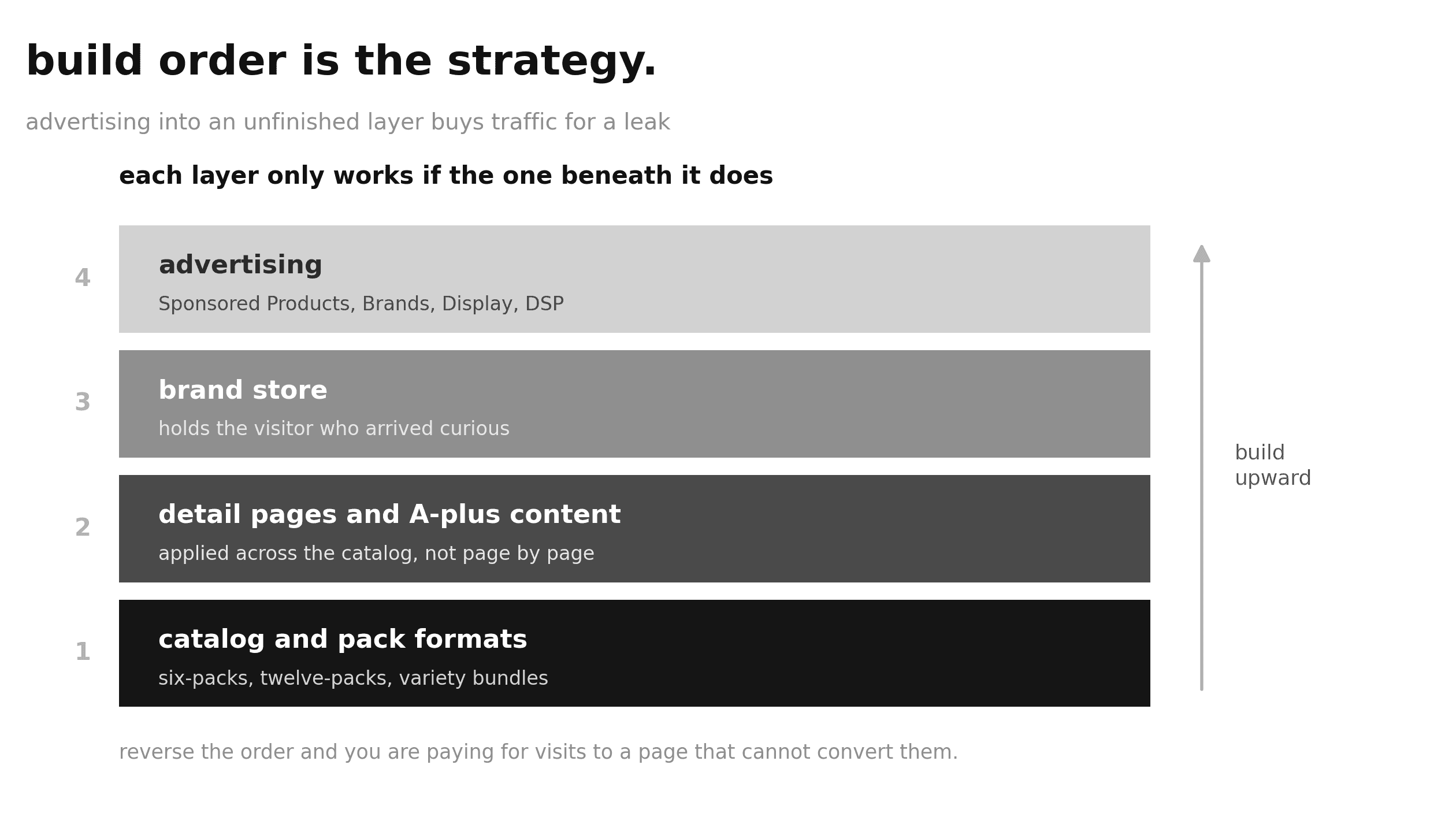
The build order was deliberate: catalog, then detail pages, then brand store, then advertising. Advertising into a page that does not convert buys traffic for a leak.
Darkroom rebuilt the Amazon presence as an e-commerce system rather than a set of listings. That meant an A-plus content system applied across the catalog rather than page by page, and flavor-first carousels that made the difference between styles legible at thumbnail scale, which is the size at which most of these decisions are actually made.
Pack format is where beverage brands lose the most ground and notice it the least. Six-packs, twelve-packs and variety bundles are different products with different buyers and different keyword demand, and treating them as one listing family flattens all of it.
Our guide to building listings that convert covers the sequencing, and the A-plus content elements worth testing first sit in a separate read.
The brand store did the job the founder announcement could not, which is hold a visitor who arrived curious and had no idea what to buy. Brami’s store rebuild is the closest comparison in the Darkroom catalog.
Running Amazon and TikTok Shop at once is its own discipline, and we have covered how the two channels differ and when to run both elsewhere. This article is about what happened on one brand, not which channel to pick.
Demand capture: catching the traffic a founder creates
A founder announcement produces a spike that decays. Advertising infrastructure determines how much converts and how much leaks.
This is the part most celebrity-founded brands get wrong. Tom Holland’s involvement generated search demand for the brand name and the category at once, in a window measured in days.
That demand arrives whether or not anything is ready to receive it. The brands that capture it built the receiving apparatus before the announcement rather than after.
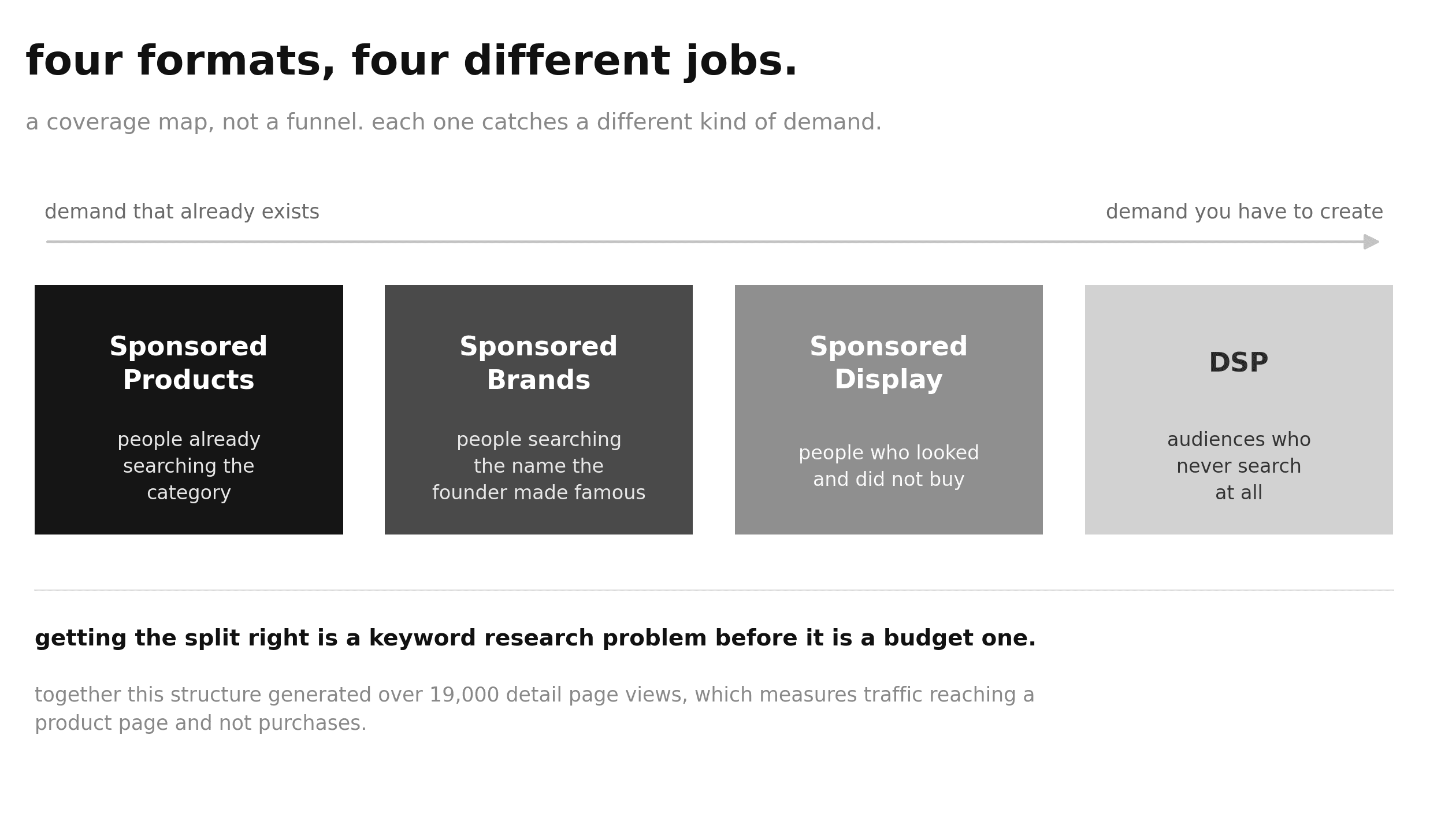
Darkroom built across all four Amazon formats: Sponsored Products, Sponsored Brands, Sponsored Display and DSP, the demand-side platform used for audience targeting off the search result. Together that structure generated over 19,000 detail page views.
Read that figure for what it is. Detail page views measure traffic reaching a product page, not purchases. It is the right metric for judging whether an advertising build is working, and the wrong one for judging whether a business is.
The four formats do different jobs. Branded terms defend the name the founder just made famous, generic category terms catch people searching for non-alcoholic beer without a brand in mind, and DSP reaches audiences who never search at all.
Getting that split right is a keyword research problem before it is a budget one. It is also the whole of Amazon marketplace management as a discipline.
Across the engagement, advertising efficiency on Amazon improved fourfold. The client reports it as an efficiency gain without specifying the underlying metric, so it is published here as reported and not converted into a return or cost ratio, which it may not be.
The creator program, and why brand fit beat reach
On a founder-led brand, creator selection is a brand safety decision before it is a reach decision. Every creator is speaking next to the founder’s name.
The TikTok Shop program produced over 100 creator videos, and the selection principle was the opposite of the standard affiliate playbook. Partnerships were chosen for brand fit rather than for volume-driven affiliate content, which means turning down creators who would have delivered more views.
That trade is easy to describe and hard to approve. Volume-led affiliate recruitment produces a bigger number in the deck and a much wider distribution of tone.
On a brand where the founder is the brand, tone is the asset being protected. A creator whose content is technically on-brief and culturally wrong costs more than the orders they bring.
It is also worth being precise about what 100 videos is. It is a count of output, not a performance figure, and the case study attaches no revenue to it. Anyone using creator volume as a proxy for creator results is measuring the wrong thing.
The mechanics of running this properly, including how affiliate structures and creator programs compound, are a separate subject. So is the operational side of a TikTok Shop program, which is where social commerce stops being content and starts being retail.
What two promotional events proved
Promotional events are where a launch system gets stress-tested, because everything that is nearly working stops working under load.
Two separate events, and they should not be read as one. During the Big Spring Sale, opening day produced 330 units and a 229 percent lift against this account’s March daily average, and the full event moved 1,663 units across all pack formats.
Separately, and at a different point in the year, Prime Day produced sales growth of 11.5 percent.
The 229 percent only means something with its baseline attached. It is measured against this account’s own March daily average, not against a category benchmark and not against the prior year. Stripped of that comparison, it becomes a claim nobody made.
The unit figures need the same care. The 330 is one day, and the 1,663 is the whole event, so the first is contained inside the second rather than added to it.
What the two events demonstrate together is that the infrastructure held. A brand that can convert a promotional window across multiple pack formats has a working catalog, working detail pages and an ad structure that absorbs a spend increase without collapsing in efficiency.
That is a different thing from a good week. Any Amazon Prime Day strategy that skips the first three depends on luck for the fourth.
What transfers to your brand
Four decisions here are portable, and none depends on having a famous founder.
The move | What it protects | The blocker you will hit |
|---|---|---|
Build the detail page before the ad account | Conversion on traffic you have already paid for | Launch calendars set by press dates, not readiness |
Treat pack format and fulfillment as advertising decisions | Whether your ads can serve at all | Operations teams who do not know ad eligibility depends on them |
Select creators for adjacency, not follower count | The tone of the brand under someone else’s voice | Brand teams optimizing for reach because reach is countable |
Plan for the decay curve before the spike | The second month, which is the one that matters | Boards reading week-one numbers as a run rate |
The last one is the one nobody plans. A launch spike is a fixed quantity of attention arriving on a known date, and the only variable you control is how much of it lands somewhere that converts.
These transfer to any brand with a talent, athlete, or founder story generating attention that is not converting, which is a larger group than it sounds. The same discipline applied to a consumer packaged goods brand without a famous name attached looks almost identical.
If your launch produced a great first week and a disappointing second month, the problem was never the launch.
Darkroom builds and runs marketplace programs for consumer and enterprise brands, across Amazon, TikTok Shop, and the retail media layer around them. Book a call with the Amazon team and we will tell you which part of your marketplace is leaking.
Frequently asked questions
Who owns Bero?
Tom Holland founded it. The company sells a premium non-alcoholic beer in several styles, reaching buyers direct and through marketplaces including Amazon and TikTok Shop. Darkroom is the growth agency behind the marketplace build, covering Amazon creative, retail media and the social commerce launch program.
What is Bero non-alcoholic beer?
It is a craft-forward non-alcoholic beer sold in several styles and pack formats, positioned as a premium product rather than a substitute one. The commercial challenge it faced was common to premium launches: strong brand identity and a marketplace presence that did not yet reflect it.
How do you launch a beverage brand on Amazon?
In build order. Catalog and pack architecture first, then detail pages and A-plus content, then the brand store, then advertising. Reversing that sequence means paying for traffic to pages that cannot convert it, which is the most expensive mistake available at launch.
Should a new beverage brand sell on TikTok Shop or Amazon first?
Usually neither exclusively. The two serve different demand: Amazon captures people already searching, TikTok Shop creates demand among people who were not. Which comes first depends on whether your bottleneck is awareness or conversion, a question covered in depth in our channel comparison.
How many creators does a TikTok Shop launch need?
There is no correct number, and treating it as a target produces the wrong roster. Bero’s launch used over 100 videos, but the operative decision was fit rather than count. On a brand carrying a founder’s name, one poorly matched creator costs more than ten well-matched ones return.