DTC MARKETING
Supplement Advertising: What You Can Claim, What Gets Rejected, and What Still Converts




Written by Darkroom leardership
Time to read: 10 min
Last update: August 11, 2026

If your ads keep getting disapproved and nobody can tell you exactly why, this article is the diagnosis. It covers what you can actually claim, how much evidence you need behind it, why the disclaimer on your label does less than you think, and what still sells when the efficacy claims come off.
It is written by marketers who run these channels rather than by lawyers. Treat it as a way to write sharper briefs and lose fewer assets to review, not as legal advice.
The reason this is confusing is that nobody owns the whole picture. Your legal counsel knows the statute but not why Meta rejected a specific asset. Your media buyer knows the rejection codes but not the evidence standard underneath them. The rules only make sense when you look at all three layers together, which is what this page tries to do.
One thing worth settling early. Platforms classify on the claim, not on the shelf. A greens powder, a sleep gummy and a functional beverage brand hit identical rejections the moment their copy crosses the same line, so if you sell a functional product of any kind, this applies to you even if you have never called yourself a supplement company.
Who actually regulates supplement advertising?
Two federal regulators with two different jobs, and then the platforms on top of both. Confusing the three is the root of most avoidable mistakes in this category.
The FTC governs advertising. It cares whether your claim is truthful and whether you can prove it, and it applies that standard to every word you publish: the ad, the landing page, the email, the packaging insert and the creator video. It does not pre-approve anything. It acts after the fact.
The FDA governs labelling and what a product is permitted to say about itself as a product. Its central rule is the line between a supplement and a drug. A supplement may describe how an ingredient affects normal body processes. The moment it claims to treat a condition, the FDA's position is that you are marketing an unapproved drug, and no amount of careful phrasing moves it back.
The platforms then apply their own rules, which are stricter than the law in some places and simply different in others. This surprises people the most: a claim can be fully compliant with federal law and still get your account restricted, because a platform is under no obligation to accept advertising it does not want to run.
Practically, that means passing legal review is necessary and not sufficient. A claim has to survive all three filters, and the cheapest place to fix it is in the brief, before anyone has produced the asset or booked the creator.
What counts as substantiation, and how much do you need?
The standard is what the FTC calls competent and reliable scientific evidence: research conducted and evaluated objectively by qualified experts, using methods generally accepted in the field. That test applies to the implied claim as well as the literal one, which matters more than it sounds.
The FTC's Health Products Compliance Guidance, published in December 2022, is the operative document. It superseded the 1998 supplement advertising guide, so anything still citing the older guide is working from a version that has not been current since 2022.
On the question everyone actually asks, which is how much evidence is enough, the guidance is more reasonable than its reputation. Randomised controlled trials are described as the most reliable form of evidence, but the FTC states there is "no requirement for a specific number of RCTs" and that "the quality of the research is more important than the quantity."
There is one exception worth knowing, and it sits at the top of the ladder. The FTC's Notice of Penalty Offenses Concerning Substantiation lists as an unlawful practice representing that a product treats, cures or mitigates a serious disease "without possessing and relying upon at least one human clinical trial of the product that (1) is randomized, (2) is well controlled, (3) is double-blinded" and that yields statistically significant results.
So the flexible position on trial numbers does not extend to disease claims. That is another reason to treat the top of the ladder as closed rather than as a phrasing challenge.
The other catch is relevance. Evidence has to match the claim you are making: your ingredient, at your dose, in your form, in a population resembling your customer, measuring the outcome you are implying. A well-run trial on a different dose in a different population is not substantiation for your ad. It is background reading.
How do you turn a claim you want into one you can actually run?
Most compliance problems are really translation problems. The claim the brand wants to make is usually a disease claim wearing marketing clothes, and there is almost always a defensible version of the same idea one rung down.
The mechanism to understand is the structure/function claim: a statement about how a nutrient affects the normal working of the body, as opposed to a statement about a disease. The FDA's own example is the clearest one available, that calcium builds strong bones. Normal function is permitted territory. Disease is drug territory, and there is no marketing route into it.
What the brand wants to say | Why it fails | A version you can run | What that version needs behind it |
|---|---|---|---|
Cures anxiety | Names a diagnosable condition. This is a drug claim | Supports a calm, focused state | Human data on your ingredient at your dose against a validated mood or stress measure |
Reduces inflammation | Inflammation reads as a disease process being treated | Supports a healthy inflammatory response | Published human data on the specific marker you are implying |
Clinically proven to boost immunity | The penalty notice lists falsely representing that a claim is scientifically or clinically proven as an unlawful practice in itself, and immunity language reads as disease prevention | Provides 200% of the Daily Value of vitamin C, which supports normal immune function | Nutrient content is verifiable from your own specification. The function claim rests on established nutrient science |
Lose 20 lbs in 30 days | A quantified outcome on a timeline is the hardest claim in the category to support | Supports your weight management routine alongside diet and exercise | A trial on the finished product, not on one ingredient in isolation |
Doctor recommended | An endorsement claim, governed by the FTC's Endorsement Guides. It has to be genuine, representative, and any paid relationship disclosed | Formulated with [name], [credential] | The agreement itself, plus substantiation for anything the endorser says on your behalf |
Read that table as a ladder rather than a list of bans. Each right-hand entry says the same commercial thing as the left-hand one, at a level you can defend if someone asks you to.
The useful discipline is to run the fourth column first. Before anyone writes copy, ask what evidence you already hold, then build the claim upward from it. Teams that work the other way round, writing the claim they want and hunting for support afterwards, are the ones who end up with an approved asset they cannot actually defend.
It also changes who owns the problem. A claim ladder built once, with your evidence file beside it, turns every future review from a negotiation into a lookup.
Does the FDA disclaimer actually protect you?
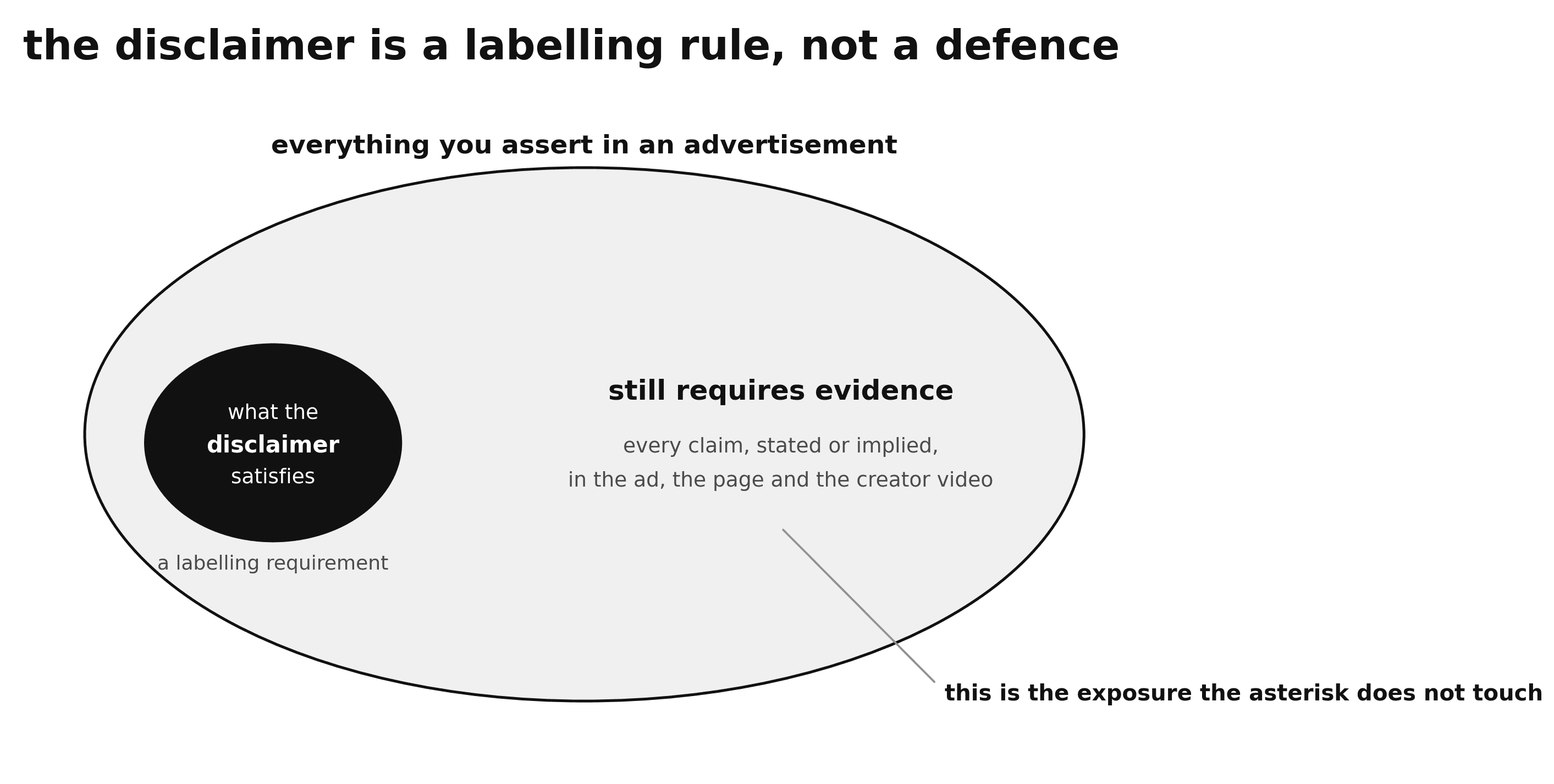
No. This is the single most expensive misunderstanding in the category. The disclaimer comes from the Dietary Supplement Health and Education Act (DSHEA), and the FTC has addressed its limits in writing: "the DSHEA disclaimer or similar statements won't cure an otherwise deceptive ad, particularly where the deception concerns claims about the health-related benefits."
The disclaimer and your substantiation are separate obligations. Running the asterisk does not lower the evidence bar by any amount, and a deceptive claim with a disclaimer attached is still a deceptive claim.
What the disclaimer does do is satisfy a labelling requirement, and the wording is fixed. 21 CFR 101.93 requires: "This statement has not been evaluated by the Food and Drug Administration. This product is not intended to diagnose, treat, cure, or prevent any disease." Where more than one claim appears, it becomes "These statements have not been evaluated."
The formatting is prescribed too, and it is where brands get caught. The disclaimer must be in boldface, no smaller than one-sixteenth of an inch, placed adjacent to the claim with nothing in between or linked to it by a symbol such as an asterisk, and repeated on each panel or page carrying such a statement. When it is not directly adjacent, it has to be boxed.
Two more things worth knowing. Structure/function claims are not pre-approved by anyone, so the responsibility for substantiating them sits entirely with you. And you are required to notify the FDA of the claim within 30 days of bringing the product to market.
Why do supplement ads get rejected on every platform?
Because four failure modes recur everywhere, mapping onto the same underlying legal risk. Learn to spot these in a brief, and you will pre-empt most rejections without memorising four separate rulebooks.
Disease and treatment language. Any verb that implies fixing a condition. Google, for example, prohibits claims that a product is "safe or effective for use in preventing, curing, or treating a particular disease," and bans several ingredient categories outright including ephedra, hCG for weight loss, and any supplement with active pharmaceutical or dangerous ingredients. No certification pathway unlocks these, which advertisers often assume there is.
Before-and-after and body-image imagery. Transformation visuals, scale shots and idealised body comparisons are restricted almost everywhere, independent of whether your claim is substantiated. The image is the claim.
Copy that implies you know something about the user. Second-person lines addressing a health condition, such as "struggling with joint pain?", are treated as an assertion about personal attributes. Rewrite to describe the product rather than diagnose the reader.
Creator claims you never approved. This is the largest uncontrolled exposure most supplement brands carry, because a creator saying it counts as you saying it. The FTC's Endorsement Guides, revised at 16 CFR Part 255 and published in July 2023, set the standard.
The companion endorsement penalty notice names the specific failures: claiming an endorsement that was never given, misrepresenting whether an endorser is an actual or current user, using an endorsement to carry a performance claim you could not make directly, failing to disclose a material connection, and presenting one person's result as typical.
That last list is worth reading against your current creator brief. Brief creator content with an explicit list of phrases that cannot appear, then review the finished videos rather than the scripts, because the claim that gets you in trouble is usually improvised on camera.
Some categories also sit behind approval gates, so confirm category eligibility before you build a launch plan around a channel.
Now the part that makes this page worth keeping open. Policies change without notice and vary by market, so the only reliable version is the one on the platform's own site on the day you need it.
Platform | What to open | What we found, and when |
|---|---|---|
Meta | Advertising Standards, health and wellness section, at transparency.meta.com | Deliberately unlinked. The policy pages are not reliably reachable through search and the paths move, so bookmark the standard from inside your ad account rather than trusting a summary. Checked 11 August 2026 |
The most explicit of the four, naming prohibited ingredients and claim types directly. Checked 11 August 2026 | ||
TikTok | Advertising policies, healthcare and pharmaceuticals, at ads.tiktok.com | Deliberately unlinked, for a different reason. This policy carries market-specific requirement tables and there was no United States entry among them, so the operative line is the general requirement to comply with local law. Confirm against your own market. Checked 11 August 2026 |
Amazon | Dietary supplements policy in Seller Central | No public link exists. It sits behind a seller login, and the requirements go well beyond anything the ad platforms ask for, including documentation and testing evidence. Checked 11 August 2026 |
Write the date you checked next to each one, the way this table does. A reference page nobody re-checks is worse than no page, because it produces confidence instead of a check.
What can you advertise when you cannot make efficacy claims?
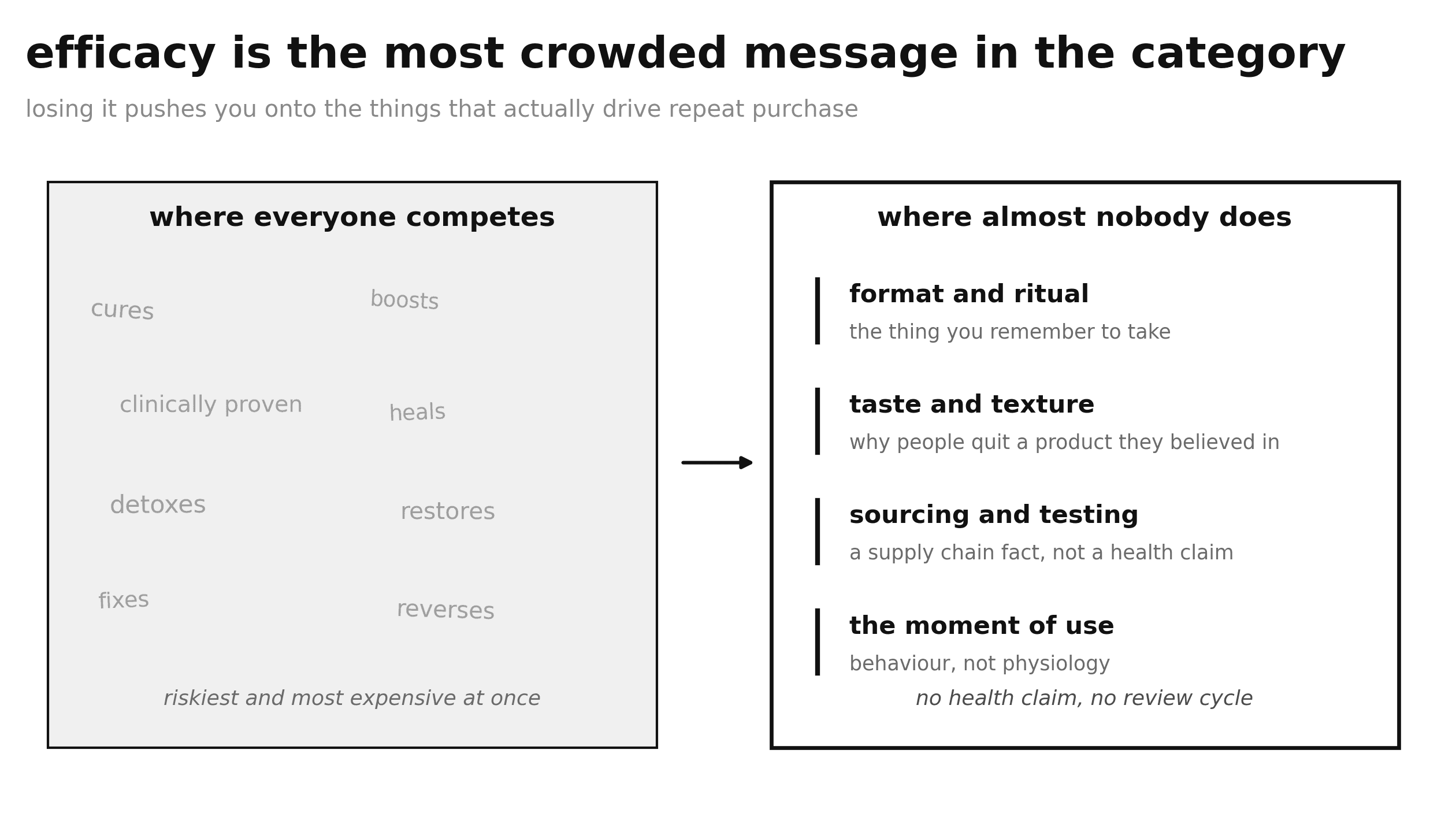
Quite a lot, and the constraint is less of a handicap than it feels like. Efficacy is the most crowded message in the entire category, which makes it the most expensive place to compete as well as the riskiest, and it is rarely the reason someone actually buys.
What moves product is closer to the surface.
Format and ritual. The two-minute morning routine, the thing you actually remember to take. Adherence is the real product, and describing it makes no health claim at all.
Taste and texture. The single most common reason people abandon a supplement they believed in, and almost nobody leads with it.
Sourcing and third-party testing. A factual claim about your supply chain rather than a health claim, and the compliant brands are strangely quiet about it.
Then there is the moment of use. Showing when a product fits into a real day outperforms telling people what it does to their biology, and it happens to sidestep the entire claim problem, because you are describing behaviour rather than physiology.
The operational trick is to build claim-safe creative as a testing pool rather than a compromise. Approve a bank of phrases legal has already cleared, then vary hook, format and pacing around them. That way you can keep testing creative properly at volume without a review cycle blocking every iteration, and without risking the account on a phrase somebody improvised.
This matters most where creative and conversion sit in the same surface, which is exactly how creative and commerce compound on shoppable channels.
Darkroom runs TikTok Shop as an operated channel for high-growth consumer brands, including creator and affiliate program management, which is where claim risk actually concentrates. If your creator program is producing content nobody reviews before it goes live, that is the conversation to have.
What changes when you sell supplements on a marketplace?
The marketplace becomes a fourth regulator, and your claim surface stops being the ad. It widens to the listing, the A+ content, meaning Amazon's enhanced listing modules, plus the storefront, the product images and, to a degree you cannot fully control, the reviews.
Marketplaces also demand things ad platforms do not, including documentation, testing evidence and supplier records, with supplements among the most heavily gated categories anywhere in ecommerce. Expect the rules to differ by marketplace rather than assuming one approval travels.
Two practical consequences. Your compliance review has to cover listing copy that converts with the same care you apply to ad copy, since it is doing more selling and gets reviewed less. And brand registry is worth prioritising, because control over your own listing content is control over your own claim surface.
This is also where thin creative costs the most, and creative is not an afterthought on a channel where the listing is the entire sales conversation.
One number to keep in view while you weigh all this. Under 16 CFR 1.98, the maximum civil penalty for the relevant FTC Act provisions is currently $53,088 per violation, an amount last amended in January 2025. If you are comparing that against older coverage, note that reporting from 2023 cites $50,120, because that was the cap at the time rather than a different rule.
If marketplace is where your supplement business lives, Darkroom operates Amazon end to end, from listings and A+ content through Sponsored Products and demand-side platform (DSP) buying. We work inside these constraints daily rather than treating them as someone else's problem.
A closing note on scope. This article will help you brief better and get rejected less. It is not legal advice, and the specific claims you intend to make should be reviewed by counsel who knows your evidence file.
Frequently Asked Questions
What claims can you legally make about a supplement?
Structure/function claims, meaning statements about an ingredient's effect on normal physiology, provided you hold competent and reliable scientific evidence matching your dose and formulation. Disease claims are reserved for drugs. There is no permitted phrasing that makes a treatment claim acceptable for a supplement.
Does the FDA disclaimer let you make any claim?
No. The disclaimer is required alongside structure/function claims, but the FTC has stated plainly that it will not cure an otherwise deceptive advertisement. Substantiation and the disclaimer are two separate obligations, and satisfying the second does nothing to reduce the first.
What are the most common reasons an ad is disapproved?
Usually one of four things: disease or treatment language, before-and-after or body-image imagery, copy implying knowledge of the viewer's health, or creator claims the brand never approved. Platforms classify on the claim rather than the product category, so functional foods hit the same rejections.
How much evidence do you need behind a supplement claim?
The FTC standard is competent and reliable scientific evidence, with randomised controlled trials the most reliable form. No fixed number is required and quality counts more than quantity, but serious-disease claims need at least one randomised, well-controlled, double-blinded trial showing statistically significant results.
What is the penalty for an unsubstantiated claim?
Civil penalties under Section 5(m)(1)(B) of the FTC Act, alongside ordinary Section 5 enforcement. The April 2023 Notice of Penalty Offenses put roughly 670 companies on formal notice, which is what enables penalties against a recipient that repeats conduct already found unlawful. Receiving a notice is not itself a finding of wrongdoing.