SUCCESS STORIES
Beauty Brand Marketing: How Morphe and Darkroom Sequenced Media and Retention




Written by Darkroom leardership
12 Mins
Last update: August 12, 2026

Beauty brand marketing at scale is rarely a creative problem. It is a sequencing problem. Morphe, the color cosmetics brand, had audience, distribution across two markets and declining sales, and the recovery came from running paid media and retention as one ordered program rather than two parallel ones.
Here is what that produced.
Result | Figure | Scope |
|---|---|---|
Shopify revenue | Up 75% | Black Friday and Cyber Monday (BFCM) 2025, year over year |
Retention’s contribution | A 6% increase | BFCM 2025, year over year |
Email channel | Up 13.4% | BFCM 2025, year over year |
Retention’s share of total revenue | Up 15% | One quarter during the engagement |
Source: the client engagement. First-party figures, client-reported.
Darkroom runs paid media and retention marketing for Morphe, and took over the retention program in late August 2025. This article covers the diagnosis, why the two programs were sequenced rather than launched together, and what compounded once both were running. Full detail sits in the full engagement.
Beauty brand marketing diagnosis: a large audience and a shrinking business
Morphe was not short of customers. It was short of working infrastructure, which is a different problem and a more fixable one.
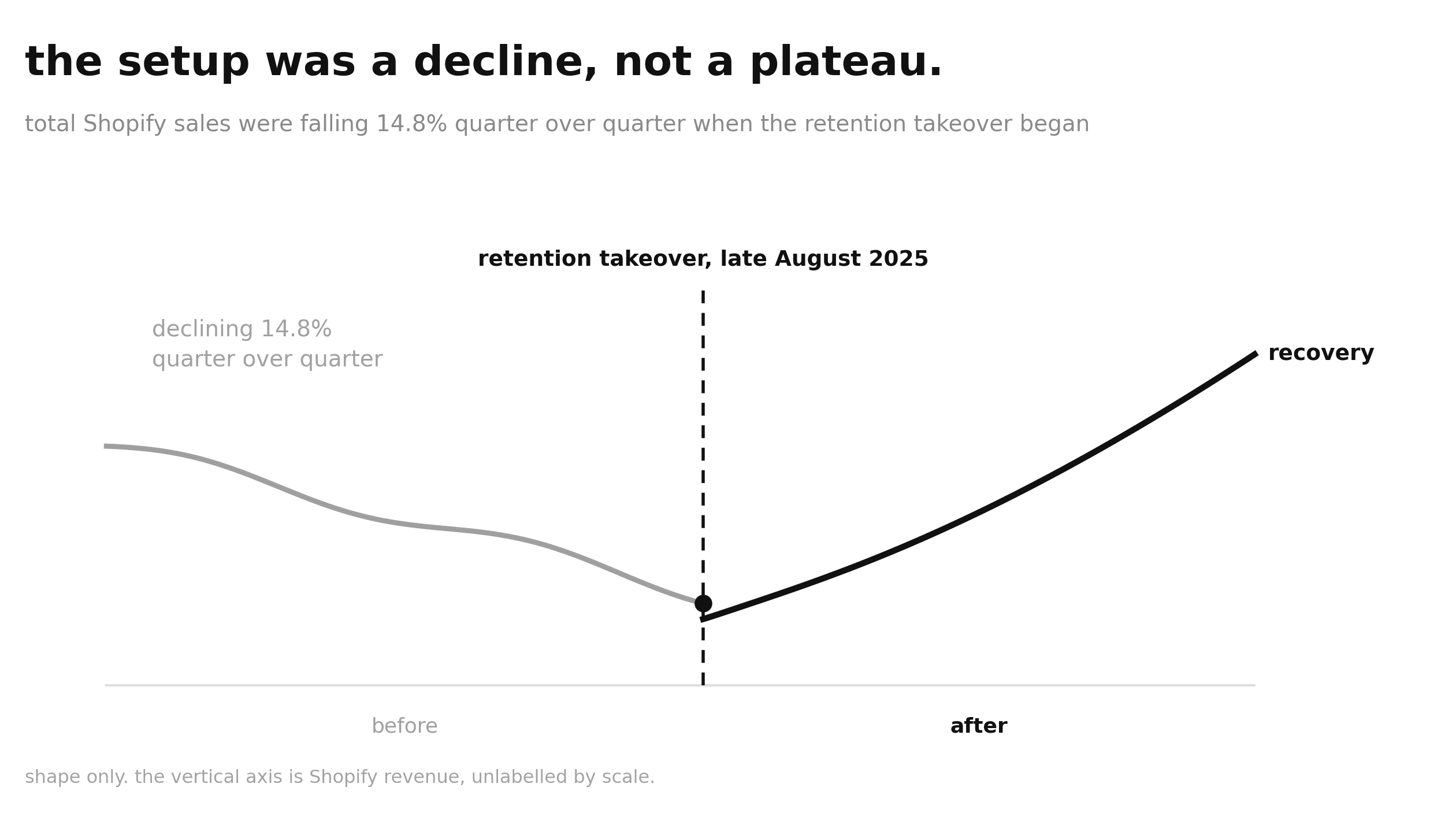
The brand operates across the US and UK with a large existing audience. Total Shopify sales were declining 14.8 percent quarter over quarter when the retention takeover began, and the reason was sitting in plain sight: the welcome series, the campaign cadence and the segmentation had not been optimized in months.
In the retention programs we audit, that combination is the most common pattern we find. A program built two or three years ago keeps running, keeps sending, and slowly stops working, because the audience changed and the flows did not.
There is a second reason this pattern persists. Retention programs are judged on channel revenue, and channel revenue at a brand this size stays large even when it is underperforming badly. A flow returning half of what it should still returns a number that looks respectable on a monthly report.
The diagnosis mattered more than the tooling. Nothing in the stack this runs on was missing. What was missing was recent judgment about what belonged in each flow, who should receive it, and how often.
That is the useful test for any brand reading this. Not whether you have the platform, but when someone last rebuilt a flow rather than edited one.
Why paid media went first and retention followed
When both paid media and retention are in scope, the order changes the return. Media was already running when the retention rebuild began, and that is the sequence rather than an accident of scheduling.
The reasoning is straightforward once you see it. A retention program is a machine for converting an audience you already have. Rebuild it against a shrinking or poorly qualified audience and you have optimized the smaller half of the problem, because the ceiling is set by who is arriving in the first place.
Media raises that ceiling and produces the volume that makes testing meaningful. A welcome flow serving a larger and better-qualified inbound audience reaches significance faster, and every subsequent test compounds against a bigger base.
Run the other way round and retention work looks disappointing for reasons that have nothing to do with the retention work. The flows are better, the audience is smaller, and the reporting shows a modest lift that gets read as a modest capability.
There is a practical benefit too. Sequencing gives each program a clean period to be judged in, which matters when two teams are being evaluated on overlapping revenue.
This is also why how paid budget gets allocated is a retention question as much as a media one, and why phasing the two is a methodology rather than a way to stage a scope.
Where should a retention rebuild start?
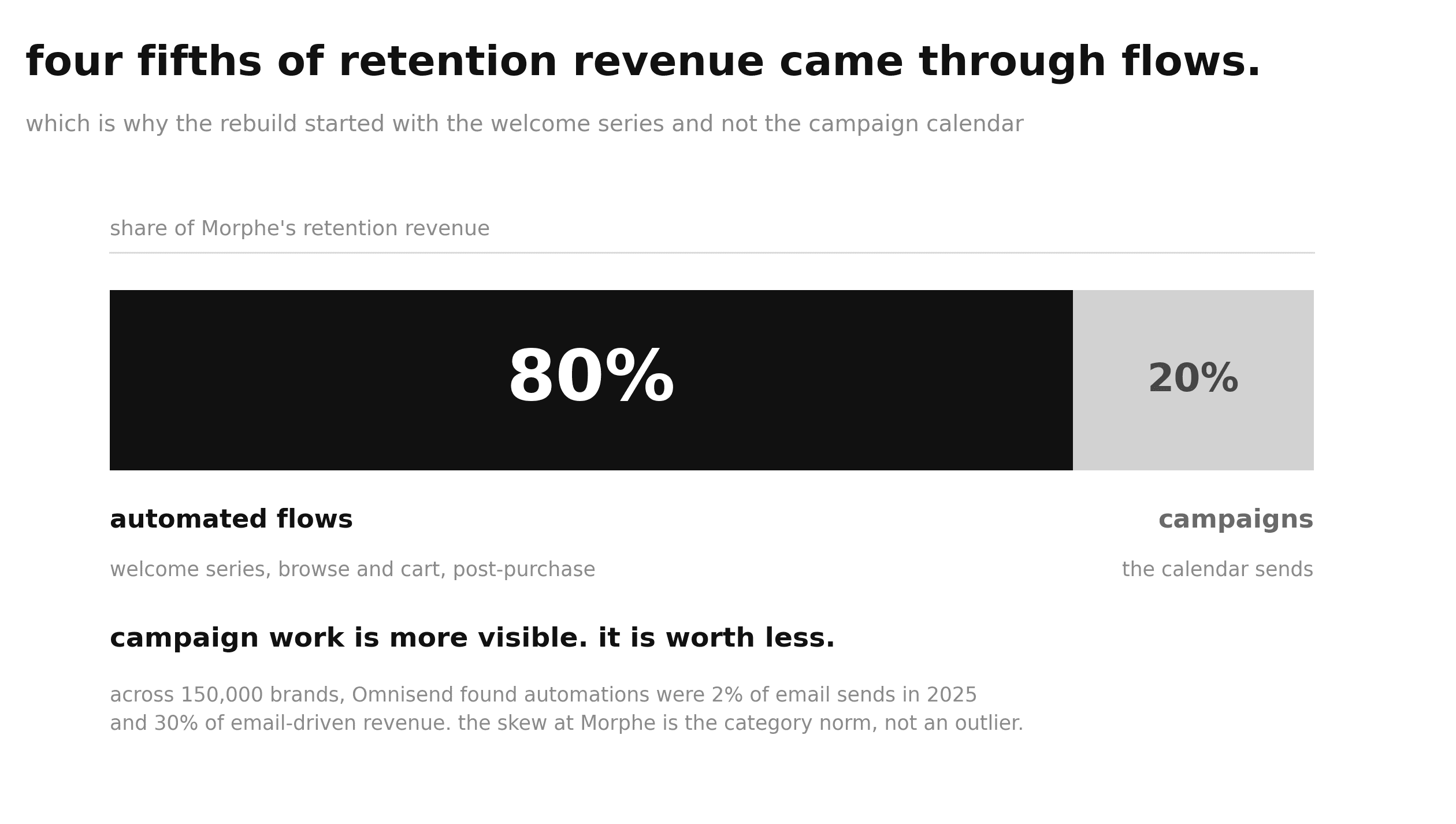
Start with the welcome series. The rebuild here began there, and the choice was structural rather than cosmetic: flows drove 80 percent of retention revenue for this brand, so campaign work first would have meant optimizing the smaller share.
That skew is not unique to Morphe. Omnisend’s 2026 ecommerce marketing report, drawn from 150,000 brands, found automations made up 2 percent of email sends in 2025 yet generated 30 percent of email-driven revenue.
The new welcome series delivered a 23 percent higher order rate and 14 percent higher revenue per recipient than the legacy flow it replaced.
That is the highest-leverage fix available in most retention programs, and routinely the last one anybody touches. Rebuilding a flow that is technically working feels harder to justify than launching a new campaign.
Klaviyo’s benchmark data, drawn from more than 183,000 customers, makes the same point from the other side: nearly 48 percent of flow-driven email revenue comes from new buyers, against 16 percent for campaigns.
Segmentation came second. Darkroom restructured it to protect deliverability, which is the unglamorous prerequisite for everything else: a program sending too broadly degrades its own inbox placement, and the revenue loss shows up everywhere at once rather than in the flow that caused it. Our guide to protecting deliverability covers the mechanics.
Campaign cadence came third, reorganized around product launches and promotional moments rather than a fixed weekly rhythm. For a makeup brand, launches are the events the audience actually cares about, and a calendar that ignores them is sending into indifference.
Flows, then segmentation, then cadence. For the detail of what a welcome series should contain and how flows carry the revenue, those are separate reads.
What disciplined testing actually changed
Testing produced the largest single result in the engagement, and it only worked because it ran inside a rebuilt flow rather than around an old one.
What was tested | Against | Result | Scope |
|---|---|---|---|
Rebuilt welcome series | The legacy welcome flow | 23% higher order rate, and 14% higher revenue per recipient | Engagement period |
Welcome discount experiment | The rebuilt welcome flow | 49% higher revenue per recipient | Engagement period |
Those two revenue-per-recipient figures are separate results and should not be added together. The 14 percent is what rebuilding the flow bought. The 49 percent is what one experiment inside the rebuilt flow bought on top of it.
The transferable point is in that distinction. A 49 percent lift on a broken flow would have produced a fraction of the revenue, because the percentage is applied to a smaller base and to an audience the flow was already failing.
Discipline here means one variable, a pre-agreed read date and a willingness to keep the losing version when the data says so. In the programs we audit, testing is almost always happening already. What is rare is testing run in an order where the results accumulate.
Order is the part that gets skipped. Testing subject lines on a flow that is about to be replaced produces findings with a shelf life of weeks, and teams do it because it is faster than rebuilding.
The sequence that works is rebuild, stabilize, then test. Only then does a winning variant keep paying after the next change.
How the two programs compounded into Shopify revenue
Shopify revenue grew 75 percent year over year at BFCM 2025, with retention contributing a 6 percent increase and the email channel up 13.4 percent.
The number worth pausing on is smaller. Retention’s share of total revenue grew 15 percent across a quarter of the engagement, which means retention was taking on more of the business at the same time the business was recovering. Share growth during revenue growth is harder than share growth during decline, because the denominator is moving against you.
Read the 6 percent carefully. The case study reports it as a 6 percent increase contributed by retention. It is not retention’s share of the 75 points, and it is not a measured incrementality result.
What the engagement demonstrates is contribution during a period when the broader business had been contracting. That is meaningful evidence, and it is not the same claim as isolation testing. Measuring retention properly means keeping that distinction visible.
The compounding shows up in the relationship rather than in either number alone. Media widened the top of the funnel, the rebuilt flows converted more of it, better conversion improved the economics of the media, and the cycle tightened.
That is the mechanism behind why retention makes ad scaling steadier. The metrics that matter are the ones tracking it across both programs rather than inside one.
What transfers to your brand
Three decisions here are portable, and none depends on being Morphe’s size.
Sequence the programs, do not stack them. If media and retention start together, the retention rebuild is measured against an audience that has not grown yet, and it will look weaker than it is.
Rebuild flows before campaigns. Flows carried 80 percent of retention revenue in this engagement. Campaign work is more visible and worth less.
Test inside the rebuilt system. The 49 percent came after the rebuild, not instead of it, and a test run before it would have measured a flow that no longer exists.
Choosing email against SMS or one subject line over another matters far less than what the flow underneath is doing. None of the three decisions is a channel choice or a platform decision, which is why they survive whatever the next tooling cycle brings.
If your flows have not been rebuilt in a year and your revenue per recipient has flattened, that is the same diagnosis Morphe had.
Darkroom builds and runs retention programs for growth-stage and enterprise consumer brands, working inside the stack you already have, whether that is Klaviyo, Attentive, Postscript or Shopify Plus. The highest-impact automations typically go live within the first 30 days.
Book a free retention audit and we will tell you which flow is costing you the most.
Frequently Asked Questions
Should you launch paid media and retention at the same time?
Usually not. Retention converts people who are already arriving, so rebuilding it before acquisition has grown that pool improves the smaller side of the equation. Getting media working first lifts the ceiling and supplies the volume that lets flow tests resolve quickly.
What did Morphe achieve with Darkroom?
At BFCM 2025 the brand posted a 75 percent lift in Shopify revenue against the prior year. Retention contributed a 6 percent increase, email rose 13.4 percent, and retention’s slice of total revenue expanded 15 percent over one quarter of the work. Figures are first-party.
Which flows should a beauty brand rebuild first?
The welcome series, before anything else. Four fifths of this brand’s retention revenue came through flows rather than campaigns, so beginning elsewhere would have meant polishing the minority. Segmentation follows, to protect deliverability, and campaign cadence comes last, once the automated layer is stable.
How much can rebuilding a welcome series improve results?
On this engagement the replacement flow lifted order rate by 23 percent and revenue per recipient by 14 percent against the version it retired. A discount experiment run inside the new flow then added 49 percent more revenue per recipient. Two separate results, not one total.
Does retention work when overall sales are declining?
Yes, and this engagement shows it. Store sales had been sliding 14.8 percent quarter on quarter beforehand, yet the retention channel still grew. Read that as contribution during a downturn rather than as an isolated causal result, which would need a controlled test.