SUCCESS STORIES
AI Performance Creative: How Fellow Got New Angles Without a New Shoot

Written by Darkroom leardership
Time to read: 10 minutes
Last update: August 18, 2026

AI performance creative isn't about asking AI to make you an ad. It can, and the results usually look like it. The question worth asking is what AI does to the economics of the ad you already know works: you art-direct one scene, approve it once, and keep shooting inside it long after a shoot would have wrapped.
At Darkroom, we ran a catalog campaign for Fellow, the coffee-gear brand. The interesting part wasn't the first ad. It was that the first ad turned into a set we could keep shooting in after the crew would normally have gone home, and that the second thing we shot in it was aimed at a completely different job than the first.
The shoot establishes product truth; the approved scene produces the volume paid media consumes, without a second production. Here is how it works.
The brief that usually produces a nice-looking dead end
A catalog ad is a sequencing problem, not a design problem.
You have a deep range, several colorways, and a paid team that needs new angles every two weeks. So you book a shoot, plan every frame, and get back exactly the frames you planned. Then the data arrives and tells you which one worked. By then the set is struck, the crew is gone, and the only thing left to do with the winner is run it until it fatigues.
Every brand feels that as a budget problem. It isn't. You commit your production spend before you have any information, and you receive your information after you can no longer act on it.
Traditional photoshoot | AI scene system | |
|---|---|---|
Angles available | Only those booked in advance | Any angle, generated on demand |
When you learn what works | After the set is struck | While the scene is still open |
Cost of asset #2 | Full second production | For asset #2, the cost represents 10-25% of the effort required for asset #1 |
Motion from the same setup | Second shoot day | Same scene, camera moved through it |
Product fidelity | Inherent | Real product files in, manual quality control out |
What makes an AI performance creative concept work? Start with the story the brand hasn't told
A working AI performance creative concept starts with an angle the brand hasn't shown, not with a tool. The brief was Fellow's product catalog, angled on color. Fellow's industrial design is genuinely good, which is an advantage, but "nice design" isn't an angle. So we got specific and grouped the catalog by colorway.
That single decision does four jobs at once.
It manufactures range: a grouped set reads as a deeper, more considered catalog than the same products shown loose. It creates a context the brand has never shown. Fellow's own store merchandises by product type, not by color (checked August 2026), so this isn't a prettier photo of a known thing; it's a new way to see the range.
It also packs the products together so the design language contrasts against itself, and each object reads harder than it would as a hero shot.
And it speaks to something the merchandising logic doesn't fully explain. Our working thesis from running paid for design-led brands: a color palette is a taste signal. It tells a customer whether a brand shares their sensibility before they've read a word of copy, and plenty of people are quietly loyal to a color.
Show them a full range of well-made objects that all live in theirs, and you haven't shown them a catalog; you've shown them a brand that matches how they'd like their kitchen, their desk, and their morning to look. For a brand whose design is already a conversion point, that reaches a different part of the decision entirely. Not is this good. Is this mine.
Worth being blunt about the order of operations. The merchandising idea came first. The tooling came after. An AI pipeline pointed at a weak angle produces weak work faster.
How to art-direct an AI scene before you generate anything
The art direction happens before any tool opens: the scene's world gets decided first, and only then does a model execute it.
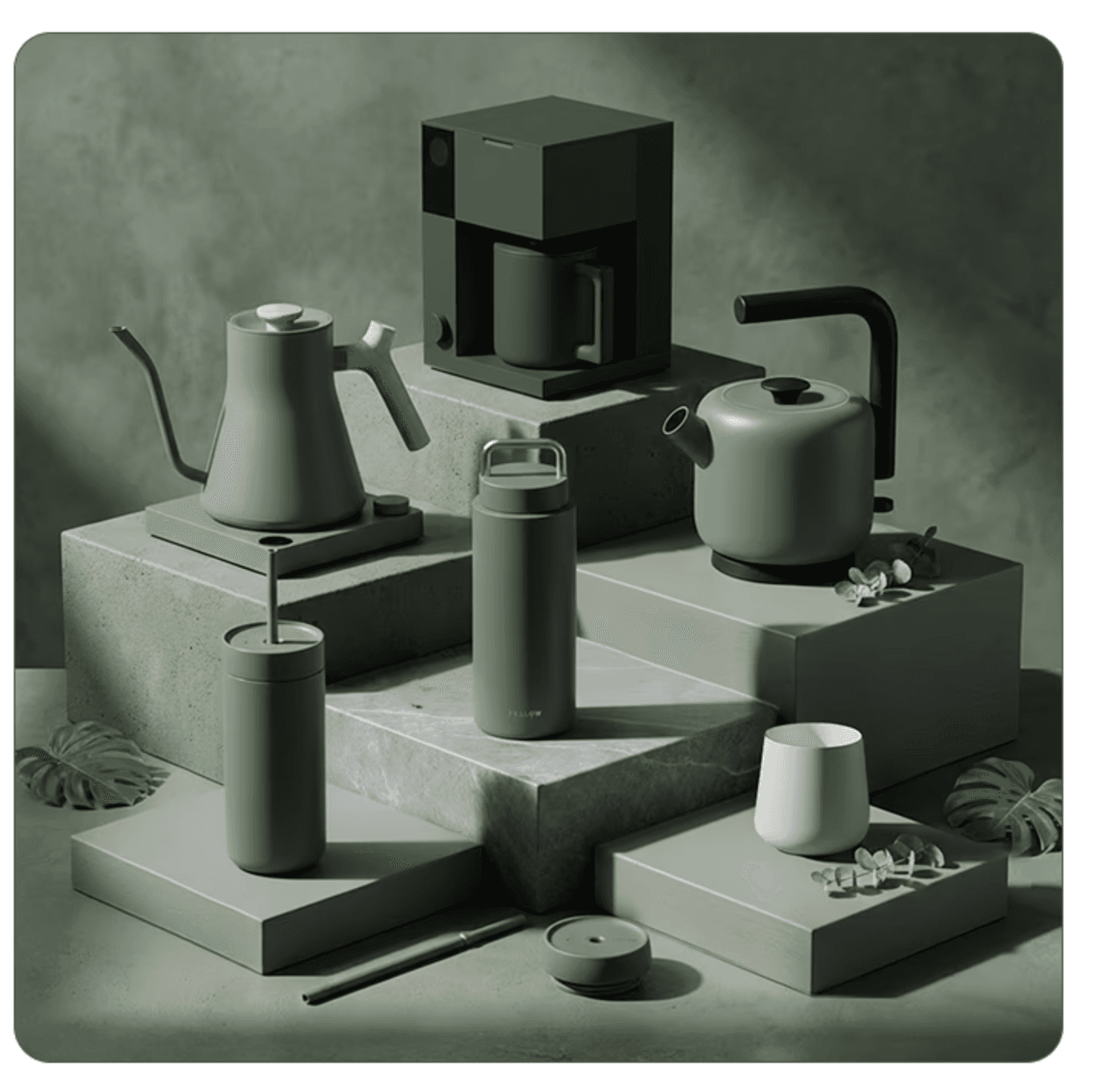
The first colorway, a green family with two tones in the same frame, one darker and one lighter, started from a single reference image rather than a written brief. Not a specification. An image, and a question about what world it belonged to.
Answering that question is the part of this process nobody talks about, and it's the part that decides the outcome. Before any tooling was opened, the work was art direction research: a deep pass across photoshoot references to establish atmosphere, and to decide which non-product elements had earned the right to share a frame with the catalog.
Those references then get interrogated rather than imitated: light behavior, surface, spatial logic, what the props are actually doing. The composition is understood structurally before anything is generated.
Only then does a model get involved, and it receives a resolved point of view rather than a folder of references. That distinction is the whole difference between art direction and prompting.
What came out of it was an environment, not an image: a stepped arrangement that carries the eye across the products in a line. A merchandising logic, not a decorative one. Staging, light, and the spatial rules of the room were locked and approved before a single product was dressed into the scene.
That locked environment is the asset. Every asset described in the rest of this piece exists because that environment was built properly, once.

Why a second colorway needs new art direction, not a filter
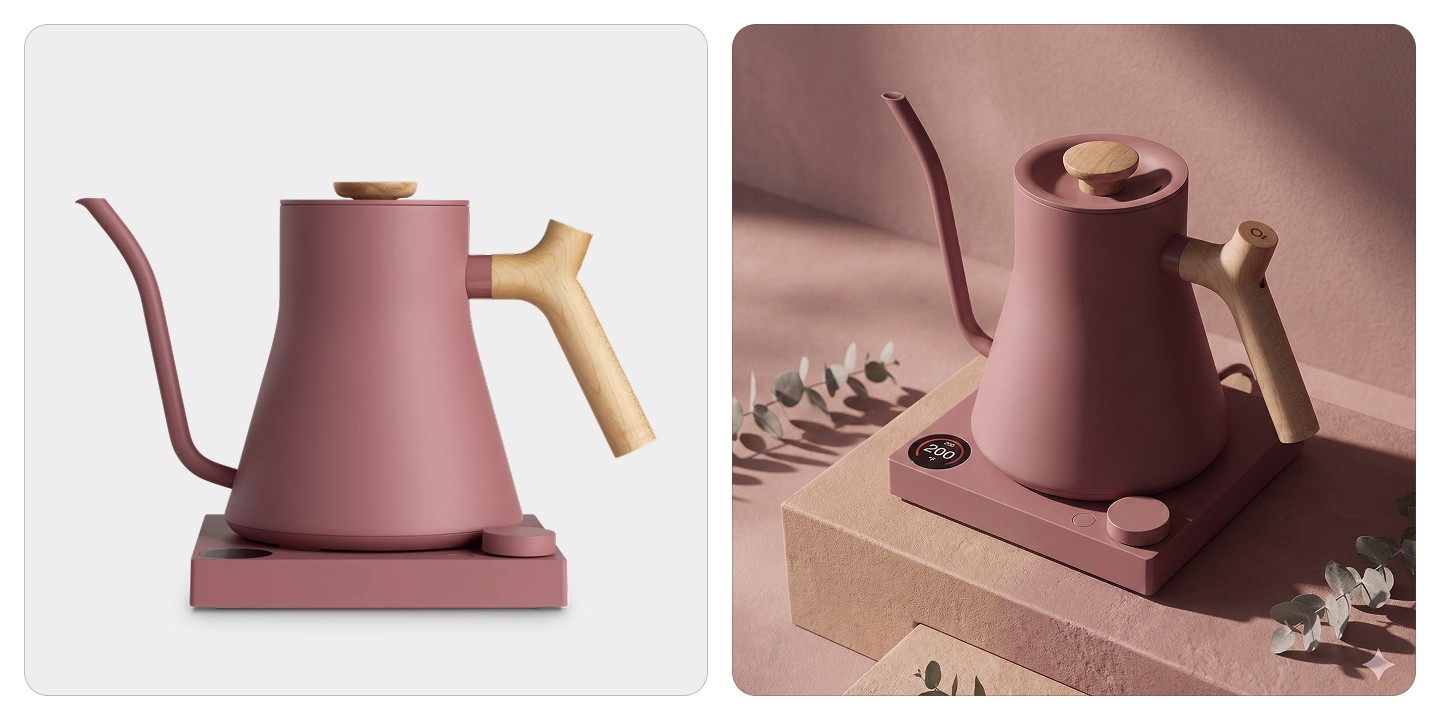
The second ad ran in Desert Rose, with Maple wood detailing on many of the products, and it needed its own direction rather than a recolor.
We kept the stepped compositional structure from the green scene. The compositional logic was sound, and there was no reason to rebuild it. What we didn't keep was the setting, because dropping a new color into the same staging would have read as exactly what it was: a recolor.
Green and Desert Rose are not interchangeable signals. Green carries nature: fresh, organic, lifestyle, a register you can brief almost directly. Desert Rose offers no such shortcut. It isn't an edible or natural cue. It reads as status, closer to luxury than to lifestyle.
So the direction moved to meet it: different light, different supporting elements, a different atmosphere around the same catalog.
The material palette came from the products themselves. The Maple was already in the frame, so the surround was built to it rather than invented for it: sandstone, warm neutral, a measure of concrete against the greener build's cooler organics. That palette also admitted more material variety than the first scene had, and the composition was better for it.
The point worth taking: these are two executions of one concept, and they still required genuinely different art direction. The second ad is not the first one with a filter on it. That is the case against treating color as a swap.
How do you keep the product accurate in AI performance creative?
The first question any brand asks, correctly, is whether that's actually their product on screen. Fidelity is controlled by what goes in, not by prompt luck.
Products enter as isolated inputs, real product files. Where the correct angle already exists, the actual product is what you're looking at. Where it doesn't, that one view is produced rather than reshot, because booking a shoot to capture a single angle of a single SKU isn't a defensible spend.
Then a manual finishing pass catches the tells. Logos, icons, buttons, any product-interface detail: this is where generated imagery gives itself away, and it gets corrected by hand as a quality control (QC) step before anything ships. Nothing goes live with a hallucinated label on it.
So: not "AI made it," and not "AI never touched it." We control fidelity at the input and verify it at the output.
How to sequence AI creative for paid media: wide first, then close
Lead wide, prove the range earns attention, then go close. That sequencing is the whole play.
Here is the problem buried inside a catalog ad. When there is this much to show at once, there is no obvious place to begin. Lead on one product and you lose the range. Lead on the range and you lose the product.
So the wide view came first deliberately, as the question rather than the safe option. Can the catalog itself stop the thumb? Is the range, arranged well, enough on its own?
It was. And that finding changes what the next asset has to do. Once the wide shot has proved the catalog earns attention, the next asset doesn't have to win attention again. It inherits it.
Which reframes the expansion entirely. It wasn't more of the same ad. It was a second area of interest, placed inside a scene that had already earned the right to be looked at. If seeing everything was enough to make them stop, then push the concept and give them more: let the details close what the range opened.
The scene could absorb that, because the scene was a world rather than a file. Light, materials, and spatial logic were resolved and approved already, so going closer was a matter of extension, not a new production.
We rewrote the direction against angles rather than products, each view written so any SKU could occupy it. Writing against angles rather than products is the engine of the method: angles are reusable, product-specific setups are not. One library of views, the entire catalog plugged through it. The environment of the original scene was read back in, so every new frame reads as having come from the same shoot on the same day.
Angle | What it is for | Which SKU types suit it |
|---|---|---|
Overhead | Reads the full arrangement as one considered set; answers the range question | Full catalog groupings; flat and low-profile products |
Three-quarter | Shows form, depth and build quality; answers "is this well made" | Hero products with distinctive silhouettes: kettles, grinders |
Side | Profile, scale and proportion against neighbouring products | Tall SKUs; paired sizes shown together |
Both concepts had shipped as static and video together from the start, with a restrained camera move on the motion cut. The scene was doing the work, so the camera didn't need to. The client leaned on the video in both cases.
A photoshoot gives you the angles you booked. A scene system gives you angles on demand, after you already know what worked.
Expand the brand world, not just the ad
There's a commercial argument underneath all of this that has nothing to do with production cost.
Darkroom's working thesis, from running paid accounts for design-led brands: consumers are saturated on manufactured vibe. They can tell when a positioning was assembled in a deck, and good design has stopped being a differentiator; it's the entry fee. What earns loyalty now is brands that commit to a world: their own color logic, their own materials, their own lore, something to belong to rather than something to buy.
Art direction has always been the soft-power lever there. What changed is its ceiling. Total control of a set used to be rationed by budget, location, and calendar: you got the world you could afford to build for two days. That rationing is gone.
The set is repeatable and open-ended, which means brand-world building stops being an occasional campaign expense and becomes something a brand can do continuously. So when we extend a client's world, the paid team gets angles, and the brand's most loyal customers get more to feed on. Same work, two returns.
It's also why we invest in this ahead of the market rather than waiting for the case studies to exist. Someone has to run the tests. We'd rather it be us, on our own dime, than learn it late on a client's budget.
What you can actually copy
Surface the angle the brand's own channels never show. Before anyone opens a tool, look for the view of the catalog the brand doesn't offer: by color, by ritual, by room, by use case. That reframe is what earns attention, and tooling accelerates whatever you point it at, including a weak idea.
Do the direction before the generation. Research the atmosphere, interrogate your references for what's structurally making them work, and arrive with a settled direction. A model given a settled direction executes it. A model given a mood folder gives you an average.
Build environments, not images. Approve a scene once, staging, light and spatial logic included, and treat it as infrastructure. The second asset inside an existing world ran 10-25% of the cost of the first, and that ratio, not the generation itself, is the return on this way of working.
Parameterize the product. Write against angles with a slot where the SKU goes, so any product drops into any view. A setup tied to one product is a one-off. A setup tied to a camera position is a permanent capability.
Anchor to real inputs and verify at the output. Real product files in, human finishing on logos and interface detail out. This is what makes the method usable for brands whose product is the design, and it's non-negotiable, because one wrong label costs more trust than the whole pipeline saves.
Sequence-wide before close. Lead with the view that answers the biggest question you have about the audience. Once it's answered, stop re-asking it. Build the next asset for the job the first one made possible.
Treat the brand world as the asset, not the campaign. Good design is table stakes and consumers can smell a positioning that was assembled rather than lived. Every scene you build should add to a coherent world, because the same work that feeds the paid account gives your most loyal customers a world to step into.
Quick answers people ask
Does this replace our photography?
No. It changes what photography is for. You shoot to establish the product truthfully and build a reference library; you generate to extend approved worlds into the angle and format volume that paid media consumes, so every shoot you do book works harder and lasts longer.
How do you keep the product accurate?
Real product files go in as inputs, angles are generated only where no reference exists, and a manual finishing pass checks every brand-critical detail: logos, icons, product interfaces. At Darkroom, accuracy is treated as an input and quality control discipline, not a prompting trick.
How fast is it, really?
The first frame takes real work, because that is where the direction and the environment get built. Everything downstream of an approved frame turns around in 3 days rather than 3 weeks, which is why we treat the first asset as an investment in a set rather than a one-off delivery.
Ready to move faster on creative?
Darkroom builds creative systems that compound instead of expiring.
Merchandising and concept strategy grounded in what your channels aren't showing yet
Reusable scene systems that produce new angles and formats without new production
Paid-media creative operations, with performance reads gated on real volume, never on return on ad spend (ROAS) alone