
PERFORMANCE CREATIVE
How Meta Andromeda Picks Your Creative in 2026 and What to Change




Written by Darkroom leardership
9 min read
September 30, 2026

Picture a Meta ads account that ran smoothly all through 2025. Same audiences, same campaign setup, a steady flow of new ads. Then results started to slip, and none of the usual fixes brought them back.
Chances are nothing broke on your side. Meta Andromeda, the system that decides which ads get a shot at each impression, kept changing under the hood.
So let's walk through how Meta ads get delivered today, what changed along the way, and what it all means for your creative and your account.
Key takeaways
Three stages: Andromeda builds the shortlist, then ranking and the auction pick the winner, so your performance creative has to hold up at every step.
A moving target: Meta merged retrieval with early-stage ranking in late 2025, and most of its reported 2026 gains came from ranking.
Concepts win: Andromeda rewards ads with genuinely different ideas behind them.
Simpler structure: fewer campaigns, broader audiences, and Advantage+ sales campaigns give it the most room to work.
Clean signals: your conversion data shapes what the system learns from every impression.
What is Meta Andromeda?
Meta Andromeda is the retrieval stage of Meta's ad system, the step that decides which ads get to compete for an impression in the first place. On its Q2 2025 earnings call, Meta described it as the stage that picks the few thousand most relevant ads out of tens of millions of candidates. The company also said it started rolling out the architecture in the second half of 2024.
The full story came out in a December 2024 engineering post. Three numbers from it still shape how people talk about Andromeda:
10,000x: the jump in model complexity Meta could run at retrieval, powered by NVIDIA Grace Hopper hardware and Meta's own MTIA chips.
+6%: the gain in retrieval recall.
+8%: the gain in ads quality on the segments Meta tested.
Let’s clear something up to avoid confusion later. Andromeda works automatically with every campaign you launch, so you don’t need to turn it on or choose a campaign type. It’s separate from GEM, which is the system that ranks ads after Andromeda creates its shortlist.
Here’s a simple way to think about it. The old system began with your guest list. Andromeda looks at the invitation, your creative, and figures out who would really want to attend.
How does Meta decide which ad someone sees in 2026?
The Meta ads algorithm works in three stages, and Andromeda handles the first one. Each stage narrows the field using its own inputs, so ad delivery in 2026 depends on getting all three right.
STAGE | SYSTEM | WHAT IT DECIDES | WHAT YOU CONTROL |
|---|---|---|---|
1. Retrieval | Andromeda | Which few thousand ads, out of tens of millions, are eligible for this impression | Creative concepts, formats and messages; campaign structure |
2. Ranking | GEM and Meta's ranking models | How likely each shortlisted ad is to drive the result you optimize for | Optimization event, conversion signal quality, creative quality |
3. Auction | Meta's ad auction | Which ad wins the impression, and at what price | Bid strategy and budget |
Retrieval: Andromeda builds the shortlist
In late 2025, retrieval took on a bigger job. On the Q3 2025 earnings call, Mark Zuckerberg said Meta had combined retrieval and early-stage ranking into a single model, which drove a 14% increase in ads quality on Facebook surfaces.
That means Andromeda now does more of the filtering than it did in 2024. And if an ad doesn't make the shortlist, its bid never gets a chance to matter.
Ranking: GEM and the Meta GEM model
Next up is GEM, the Generative Ads Recommendation Model, a foundation model Meta described in November 2025. Think of it as a coach for the ranking models: it helps them get better at predicting which shortlisted ads will actually drive results.
In August 2026, Meta published a multi-stage sequence model inside GEM that reads long histories of what people view, click, and buy. Together with its broader model work, Meta reports a cumulative lift of 6% in conversions on Instagram, 3% in conversions on Facebook, and 3.5% in ad clicks on Facebook.
Auction: bid meets predicted value
The auction is where your bid and budget come in. They set how much delivery you can buy, and they work on top of the value the ranking stage predicts for your ad.
So a bigger bid can't save creative the system expects people to scroll past.
What changed in the Meta Andromeda update since 2025?
Short version: Meta reworked the system almost every quarter, and in 2026 most of the gains it reports come from the ranking stage.

2025 marked a major year for Andromeda. Meta improved it to select more personalized candidates and rolled it out to Facebook Reels, which the company said led to almost 4% higher conversions on Facebook mobile Feed and Reels, according to its Q2 2025 call. In October 2025, Meta also combined retrieval with early-stage ranking, which contributed to a 14% increase in Facebook ad quality.
In early 2026, Meta focused on infrastructure. During its Q4 2025 call, the company said Andromeda now runs on NVIDIA, AMD, and MTIA chips, and its computing efficiency has almost tripled.
After that, the headline gains moved to ranking. On the Q2 2026 call, Meta said new user understanding models, combined with GEM and sequence learning, lifted Facebook ad clicks 8.3% and conversions 15.7% in the quarter. Its August 2026 engineering post walked through the multi-stage ranking model behind part of that work.
What does this mean for your Meta ads in 2026? Your creative still needs to pass retrieval to appear. After that, the ranking models rely even more on conversion data to decide who sees your ad next.
What does Andromeda reward in your creative?
Andromeda rewards four things: a deep pool of eligible ads, creative that makes the offer and the buyer easy to read, real interaction from real people, and enough variety to personalize. That's the heart of any solid Andromeda Meta ads strategy, and each one traces back to how Meta built the system.
A deep pool of eligible ads
Meta built Andromeda for volume. Its engineering team designed the index to leverage the exponential growth in eligible ads that Advantage+ creative automation produces, while keeping inference costs low as that pool grows.
In practice, every distinct, eligible ad you launch is one more candidate Andromeda can match to someone. Advantage+ creative enhancements add candidates to that pool as well.
Read also: 10 Creative Volume Strategies That Improve Paid Social Performance
Creative that makes the offer and the buyer easy to read
Andromeda learns what Meta's engineers describe as the latent relationships between people's interests and the products and services offered in ads. The clearer your creative is about what you sell and who it's for, the more material the model has to work with.
So show the product in use, name the problem it solves, and cast someone who looks like the buyer you want. A specific scene tells the model exactly which interests to connect. Creator content helps a lot here, since it puts a real customer on screen.
Read also: What Is UGC and Why It Outperforms Studio Creative on Paid Social
Real interaction from real people
According to Meta, Andromeda rebuilds user-ad interaction signals on the fly, so the way people respond to your ads feeds straight back into what it retrieves next. Ads that earn genuine attention, taps and purchases tend to earn a place in more shortlists.
That's why the opening seconds of every ad carry so much weight. A strong start gives Andromeda a clear early read on who the ad works for.
Enough variety to personalize
Meta says the 10,000x jump in model capacity is what makes more personalized ads possible, and its guidance on diversification with Andromeda points to creative diversification as today's main lever for finding relevant audiences.
Variety gives all that capacity something to do. When a price-driven buyer, a premium buyer and a time-poor buyer can each find an ad that speaks to them, Andromeda can match every person to the right message. Many advertisers also report that ads which look, read or sound alike end up splitting delivery among themselves, so each new ad adds the most when it brings a fresh message or a new buyer into the pool.

How should you structure a Meta account for Andromeda?
Keep it simple: fewer campaigns and ad sets, broader audiences, and more genuinely different creative in each. Every split you add divides your conversion data, and Meta's models learn fastest when that data is pooled.
Make Advantage+ sales campaigns the default
Meta's developer documentation describes Advantage+ sales campaigns as the updated, streamlined version of the old shopping campaign. The old type can no longer be created through the API, and legacy campaigns lose edit access at version 26.
Meta is clearly betting on them, too. On the Q2 2026 call, the company said its end-to-end Advantage+ solutions passed a $75 billion annual revenue run-rate. So any Meta Advantage+ plan for 2026 starts with sales campaigns.
Keep controls for what they do best
The same documentation builds a basic Advantage+ sales campaign with no targeting beyond location, and it separates existing customers from new ones with custom audience inclusions and exclusions. That's a helpful hint about where your control still lives: geography, exclusions, and the line between acquisition and retention.
Keep a testing lane
A consolidated account still has room for testing. A separate testing campaign lets new concepts earn delivery without going head-to-head with proven winners, and only the ones that work graduate to scaling.
If your account was built for 2024, this is a real rebuild, and it's exactly the kind of work a paid media team that rebuilds account structure around creative takes on first.
How do you give Andromeda clean conversion signals?
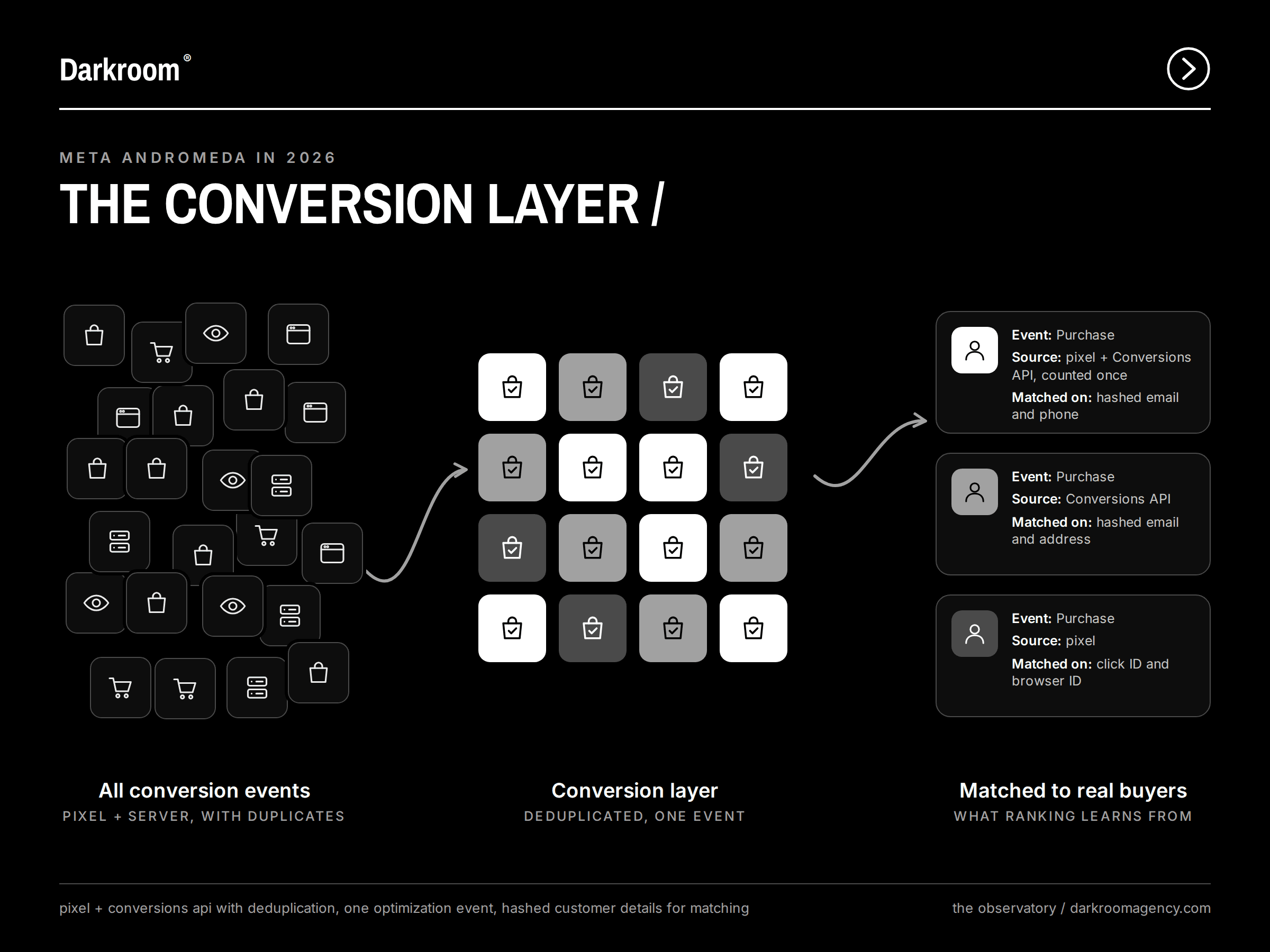
Send Meta accurate, deduplicated conversion data for one event that reflects revenue, since that's what the ranking models learn from.
Pixel plus Conversions API: run both, with deduplication on, so browser privacy limits can't hide your conversions.
One optimization event: pick the event closest to revenue and stick with it, because switching resets what the system is learning.
Match quality: check event match quality in Events Manager and pass hashed customer details wherever you can.
The most common slip we see is duplicate events, often from an app integration and a server setup both firing purchases. That inflates your results and teaches the system to go after the wrong people.
Read also: Ecommerce Analytics - The Attribution and Measurement Stack That Actually Informs Decisions
Does Andromeda make ad fatigue worse?
It affects which ads start to wear out at the same time. When the system sees certain concepts as similar, those ads reach many of the same people. As a result, they lose their impact together, and you often see fatigue across a whole group of ads at once.
Ad fatigue and ad similarity need different solutions. Fatigue happens when the same people see your ad too many times, so a new version can help get their attention again. Similarity is about structure: if your ads look too much alike, they won’t reach new people. In that case, try new ideas.
A set schedule for refreshing ads won’t fix this problem. Each account is different, depending on your audience size, budget, and ad format. The best way to find your break point is to look at your own data.
It’s also becoming more expensive to overlook this issue. Meta’s average ad price rose 12% year over year in Q2 2026, so every impression on a worn-out group of ads now costs more than it did last year.
What are the risks of letting Meta's AI run the account?
Automation is great at finding buyers, but it optimizes for what Meta can measure, leaving a few blind spots worth watching. Here are the three that show up most often:
Trusting the platform's own report card: platform-reported conversions include people who would have bought anyway, so results can look stronger in Ads Manager than they are in your revenue. Test incrementality on your largest spend to see the real lift.
Weak concepts hiding behind a winner: when one strong ad carries a consolidated campaign, the losers keep spending quietly behind it. Review results concept by concept so every ad earns its budget.
Brand drift: left alone, the system leans toward the cheapest action, which can nudge your creative toward discounts and away from the positioning you're building. Set brand guardrails before you scale.
Read also: Why Paid Media Fails When You Optimize for Platform Metrics
How Darkroom runs Meta Andromeda programs
At Darkroom, our paid media programs are designed to match how Andromeda and GEM select ads today. We use experienced team members, our own AI tool called Shadow, and a creative testing process that quickly finds top performers. Ads that do not perform well are either improved or replaced each week.
For Sculpd, we increased paid media spending from $30,000 to over $1 million by December, helping the business grow almost 100% in the fourth quarter. For Nécessaire, our new acquisition strategy led to a 118% increase in paid media revenue.
If you want to update your account to match how Meta selects ads today, reach out to Darkroom’s paid media team.
Frequently Asked Questions
When did Meta Andromeda launch?
Meta started rolling out Andromeda in the second half of 2024 and explained it publicly in a December 2024 engineering post. The company kept extending it through 2025, including to Facebook Reels, and merged retrieval with early-stage ranking in late 2025. Meta hasn't published a date for a completed global rollout.
Is Meta Andromeda the same as Advantage+?
They're two different things. Andromeda is the retrieval system that shortlists ads for every campaign type, while Advantage+ is a set of automation settings for audience, placements, budget and creative. Advantage+ sales campaigns replaced Advantage+ shopping campaigns in 2025 and give Andromeda the most freedom, which is why the two often get mixed up.
What is the difference between Andromeda and GEM?
Andromeda decides which ads make the shortlist for an impression. GEM, the Generative Ads Recommendation Model Meta described in November 2025, is a foundation model that helps the ranking models score that shortlist more accurately. Retrieval happens first and ranking second, and your creative needs to hold up in both.
Do lookalike audiences still work under Andromeda?
They still run, though with Advantage+ audience on, a lookalike acts more like a suggestion, so it rarely narrows delivery the way it used to. Before you rebuild, test broad delivery against your lookalike setup using the same creative, and keep location and exclusions as your hard controls.
What is an Entity ID in Meta ads?
Entity ID is industry shorthand, and Meta itself doesn't use the term. It describes the way Andromeda appears to group ads that look, read or sound alike and treat them as a single candidate. Meta's own advice points the same way: upload creative that differs in concept, format, and message.
How many creatives should an ad set have under Andromeda?
Enough genuinely different concepts to give retrieval real options. The right number depends on spend, audience size and how quickly your winners fatigue, which is why Darkroom's creative volume guide sizes it by account. Near-duplicates raise your ad count without adding options, because Andromeda groups them.