PAID MEDIA
10 Creative Volume Strategies That Improve Paid Social Performance




Written by Darkroom leardership
10 min read
August 14, 2026

Creative fatigue doesn't show up overnight. Your account looks stable until return on ad spend (ROAS) starts slipping, cost per acquisition (CPA) keeps climbing, and every optimization buys a little more time instead of solving the problem.
Many teams treat that as a budget issue. In most mature paid social accounts, it's a creative systems problem. The team can't produce, test, and refresh creative fast enough to keep pace with spend.
Let’s break that challenge into two parts. First, you'll see ten practical strategies to increase creative volume. Then you'll see the operating habits that keep production, testing, and creative refreshes running consistently.
What Is Creative Volume, and Why Does It Matter?
Creative volume is your team's ability to produce enough meaningful creative variations to keep paid social campaigns moving forward.
That includes new concepts, fresh hooks, different messaging angles, and format adaptations. A consistent creative pipeline creates more testing opportunities instead of relying on a handful of ads to carry an entire account.
Every campaign eventually slows down. Bid, budget, and targeting adjustments may help, but they rarely solve the problem if no new creative enters the account. Without fresh variations, the algorithm has fewer opportunities to match different messages with different buyers.
Recent industry data reflects the same pattern. In a 2025 survey report from Taboola, 74.7% of U.S. performance marketers said they had noticed diminishing returns from their social media advertising budgets.
The findings also showed that creative fatigue wasn't the only factor behind those results:
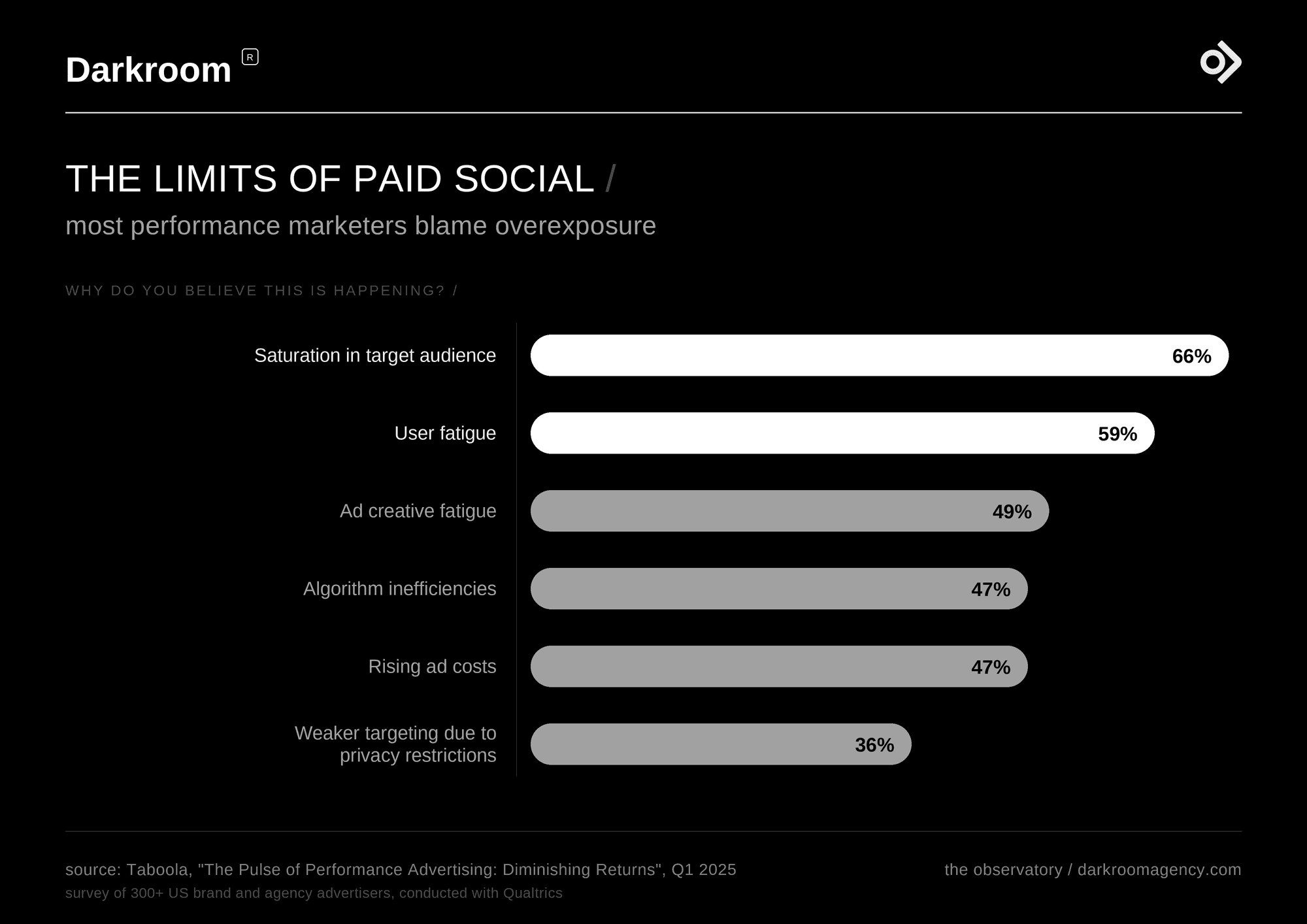
Motion's 2026 Creative Benchmarks reinforce the same idea. The report found that only about 5% of Meta ads reached at least ten times their account's median ad spend, while roughly half received little or no spend.
Those numbers highlight an uncomfortable reality: most creatives won't become winners. That's one reason performance creative has become such an important part of modern paid social. I'd rather see a team ship twenty structured tests than spend two weeks trying to predict a single winner.
10 Creative Volume Strategies That Improve Paid Social Performance
Creative volume depends on how your team creates, tests, and reuses ideas. Many paid social teams already produce enough content to run more experiments.
The problem is that they keep starting from scratch, approvals take too long, or strong ideas never make it beyond their first version.
The next strategies help you create more testing opportunities without turning every campaign into a bigger production project.
1. Build a Modular Creative System
You don't need a brand-new idea every time you launch an ad. Separate each creative into reusable pieces.
Keep hooks, opening visuals, body copy, offers, social proof, and calls to action independent from one another. One concept can then generate dozens of meaningful variations instead of a single finished asset.
Here's a simple example:
Component | Variations |
Hook | 3 |
Body copy | 3 |
CTA | 3 |
With just those combinations, you already have 27 different creatives to test before anyone needs to come up with another campaign idea.
This approach also makes dynamic creative optimization much easier. Instead of building every variation manually, platforms can mix and test interchangeable components more efficiently.
The same concept can also live in multiple formats. Turn a winning static into a short video, a carousel, or creator-led content. Every adaptation creates another testing opportunity without starting from scratch.
I'd make this change before hiring another designer. Most teams don't run out of ideas. They spend too much time recreating work they've already proven can perform.
2. Engineer Your Hooks Systematically
Treat hooks as their own testing category. They decide if someone watches the rest of your ad.
Many teams brainstorm hooks from scratch every time they launch a campaign. A simple library works much better. Group hooks by angle so you can compare patterns instead of isolated creatives.
For example, your library might include:
Pain point.
Question.
Contrarian opinion.
Specific result.
Social proof.
Unexpected statement.
Then write five to ten hook variations for each category before you produce the full creative.
Suppose you're promoting a creative automation platform. The message stays the same. Only the opening changes.
"Your creative team doesn't need another content day."
"Most Meta accounts don't have a budget problem."
"Creative fatigue starts long before ROAS drops."
"One winning ad won't carry an account for long."
"The strongest creative usually isn't the first version."
Once those ads go live, look beyond click-through rate (CTR). Compare thumbstop rate, three-second view rate, hold rate, CTR, and downstream conversion quality together.
A hook that attracts attention but brings low-quality traffic doesn't deserve more budget, no matter how many clicks it generates.
3. Diversify Your Production Sources
Relying on one production source limits creative volume sooner than most teams expect. A balanced mix gives you more formats, faster turnaround, and more testing opportunities.
Here's a practical way to split the work:
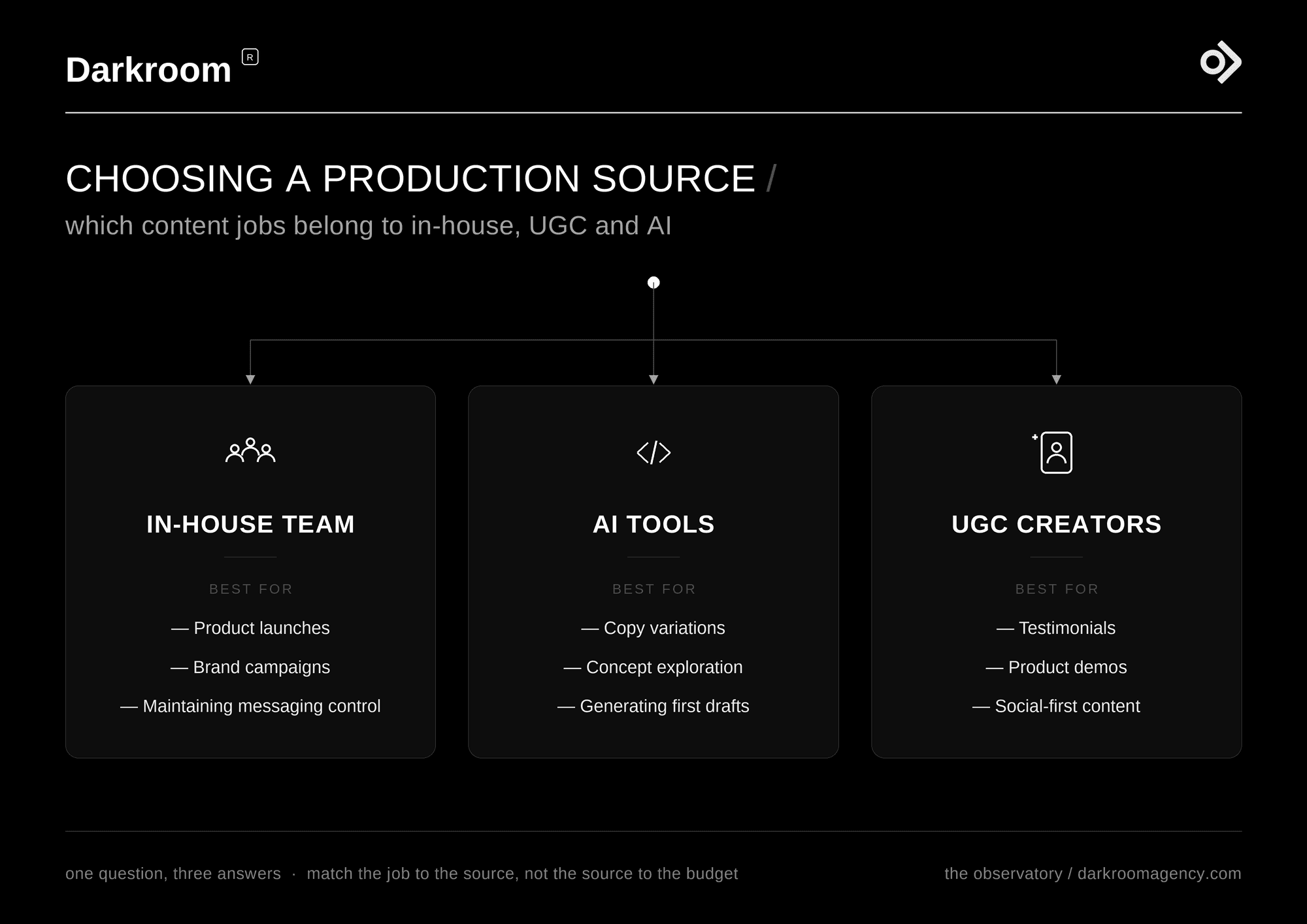
Each source solves a different problem. Your in-house team protects brand consistency. Creators bring content that feels native to social platforms. Artificial intelligence (AI) helps your team produce more variations without spending hours rewriting the same message.
I'd avoid giving AI the final word, though. It speeds up production, but it still misses brand nuance, customer context, and the judgment that turns a decent ad into a strong one.
4. Brief UGC Creators for Ongoing Volume
One-off creator partnerships rarely solve a creative volume problem.
A small roster of creators who know your brand usually produces better results over time. Building a repeatable user-generated content (UGC) program also makes it much easier to keep fresh creative entering your testing pipeline.
Just keep the brief simple. Define the hook, the key message, and the format. Then leave room for creators to speak naturally. The content performs because it sounds like them, not because they repeat your script.
Suppose you're promoting a protein powder. Give every creator the same core message, but let each person approach it differently. One might focus on post-workout recovery, another on busy mornings, and another on replacing breakfast. That gives you multiple creative angles instead of nearly identical videos.
Don't stop after the first edit, either. One creator video can become a feed ad, a Story, a Reel, or several shorter hook variations for future tests.
5. Mine Customer Language for Copy Variety
Your customers already tell you what matters to them. Pay attention to the words they choose.
Reviews, support tickets, direct messages, Reddit discussions, and sales calls reveal how different people describe the same problem. Those differences become a steady source of new hooks and body copy.
Take a project management platform as an example. One customer says, "We're constantly chasing updates." Another writes, "I spend half my day asking where things stand."
Both describe the same problem, but they speak to different buyers. Test both versions before rewriting them into polished brand copy.
I see teams make the same mistake repeatedly. They replace customer language with marketing language. The copy sounds cleaner, but it loses the familiarity that made it persuasive.
6. Test Hooks at Higher Volume
Don't wait for one hook to fail before testing the next one. Run multiple angles at the same time so you can compare performance under the same conditions.
Also, keep the evaluation focused on the metrics that explain performance, not just the ones that generate the most clicks.
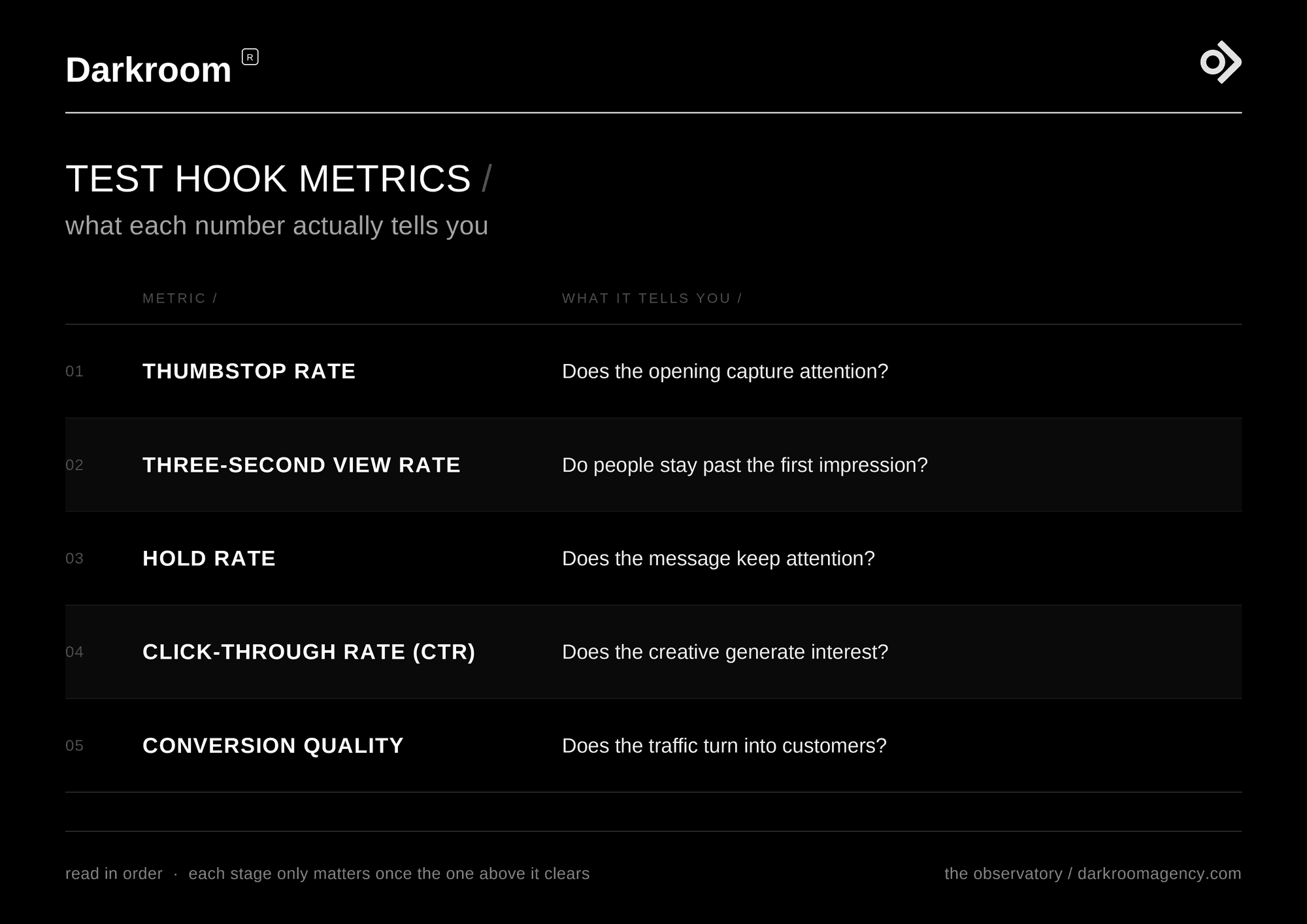
A single metric rarely tells the full story. A hook with the highest click-through rate (CTR) may bring low-intent traffic, while another attracts fewer clicks but drives stronger conversions.
Don't stop at identifying the winner. Figure out why it won. If one opening consistently outperforms the others, carry that insight into the next round of creative.
7. Adapt Winning Creatives Across Formats
A winning concept deserves more than one format.
Once an ad proves it can perform, keep the idea moving. Look for the fastest way to turn it into new assets instead of jumping straight into another creative concept.
A single concept can quickly become several assets:
Turn a Reel into a Story.
Break a long-form video into multiple six-second hooks.
Convert a static image into a carousel.
Pull a customer quote into a text-first ad.
Each version gives the platform another chance to match the same message with a different audience or placement.
Meta’s data shared in AppsFlyer's Creative Optimization Report 2025 supports that approach. Campaigns that combined different creative formats and messaging types reported up to a 32% improvement in CPA. They also achieved 9% more incremental reach.
I'd keep expanding a proven concept until performance tells me it's time to move on. Creating something new isn't always the fastest way to increase creative volume.
8. Repurpose Top Organic Content as Paid Ads
Your organic channels already tell you what earns attention. Paid social shows which ideas also drive business results.
Start with posts that generated unusually high engagement, strong watch time, or meaningful conversations. Then adapt them for paid. A stronger hook, clearer call to action, or different aspect ratio may be all you need.
Let the insights flow in both directions. If a paid creative consistently outperforms the rest, add that concept to your organic content calendar. Likewise, revisit strong organic posts before they disappear into the archive.
Too many teams separate paid and organic into different creative workflows. A connected approach usually produces better results, which is why many social media marketing services treat paid and organic as parts of the same creative system.
9. Refresh Winners Before They Fatigue
Don't wait for performance to drop before replacing a creative. Plan the next version while the current one is still working.
Most accounts show warning signs early. Frequency climbs, CTR trends down, and thumbstop rate slips. Those signals tell you more than one bad day in Ads Manager. If you track those patterns consistently, spotting Facebook creative fatigue becomes much easier. The same principles apply across paid social, even if Meta tends to reveal them first.
You don't need a brand-new concept every time. Small updates can extend a winning ad:
Replace the opening hook.
Test a different first visual.
Rewrite the call to action.
Lead with a different customer benefit.
I'd try those changes before retiring the creative completely. If the core message still resonates, a fresh execution may be all the campaign needs.
10. Use Platform Tools and AI to Reduce Production Time
AI helps creative teams produce more variations in less time. It doesn't replace creative judgment.
Creative volume usually slows down because repetitive production work consumes too much time. Copy variations, format adaptations, and new hooks all matter, but they don't always require the same level of human attention.
So, use AI where it saves the most time:
Generating copy variations.
Drafting new hooks.
Exploring different creative angles.
Adapting creatives with Meta Advantage+ Creative through automatic resizing, text overlays, and format adjustments.
That leaves your team free to review concepts, refine messaging, and decide which ideas deserve more investment.
Canva's 2025 survey of 2,400 marketing and creative leaders reflects the same pattern:
85% saved at least four hours per week with generative AI.
77% said it increased their team's creativity.
61% still struggled to fit it into existing workflows.
One-third couldn't measure its return on investment (ROI).
94% reviewed and refined AI-generated work before publishing it.
High-performing teams treat AI as part of the workflow, not as a replacement for creative judgment. Generative tools speed up production, while creative intelligence AI helps identify which hooks, messages, and formats deserve another round of testing. Even then, people still make the final creative decisions.
5 Operational Habits That Keep Creative Volume Consistent
Creative volume depends as much on operations as it does on creative output. Teams rarely struggle because they run out of ideas. More frequently, production slows down because reviews pile up, priorities change, or nobody knows what to test next.
2025 research by Adobe illustrates the problem. Among marketing teams:
36% struggled to find time for content creation and ideation.
33% cited siloed collaboration.
31% pointed to lengthy approval processes.
Even more telling, 58% said they spent more than 40% of their time managing reviews and approvals.
Those numbers point to the same conclusion. The limiting factor isn't creativity; it’s the process behind it.
These five habits help keep production, testing, and creative refreshes moving week after week:
Run time-boxed creative sprints. Produce new creative every two weeks or once a month instead of waiting until campaigns need replacements. Fixed production cycles make it much easier to maintain a healthy testing pipeline.
Systematize creative testing. Test one major variable at a time, such as the hook, opening visual, or call to action. Keep a shared library with the outcome of every test. Over time, those findings become one of your team's most valuable assets.
Set creative fatigue thresholds. Decide in advance which signals trigger a refresh. That may be a specific frequency, a drop in CTR, or another performance metric that consistently predicts declining results in your account.
Hold a weekly creative review. A 30-minute meeting is usually enough. Review what scaled, what slowed down, what needs another iteration, and which concepts deserve more investment.
Archive every retired creative. Don't delete old ads once they stop running. Save performance notes alongside each asset, so your team can revisit strong ideas, remix successful concepts, and avoid repeating experiments that already failed.
The best creative teams build on what they already know. Every round of testing gives them better direction for the next one.
How Much Creative Volume Do You Actually Need?
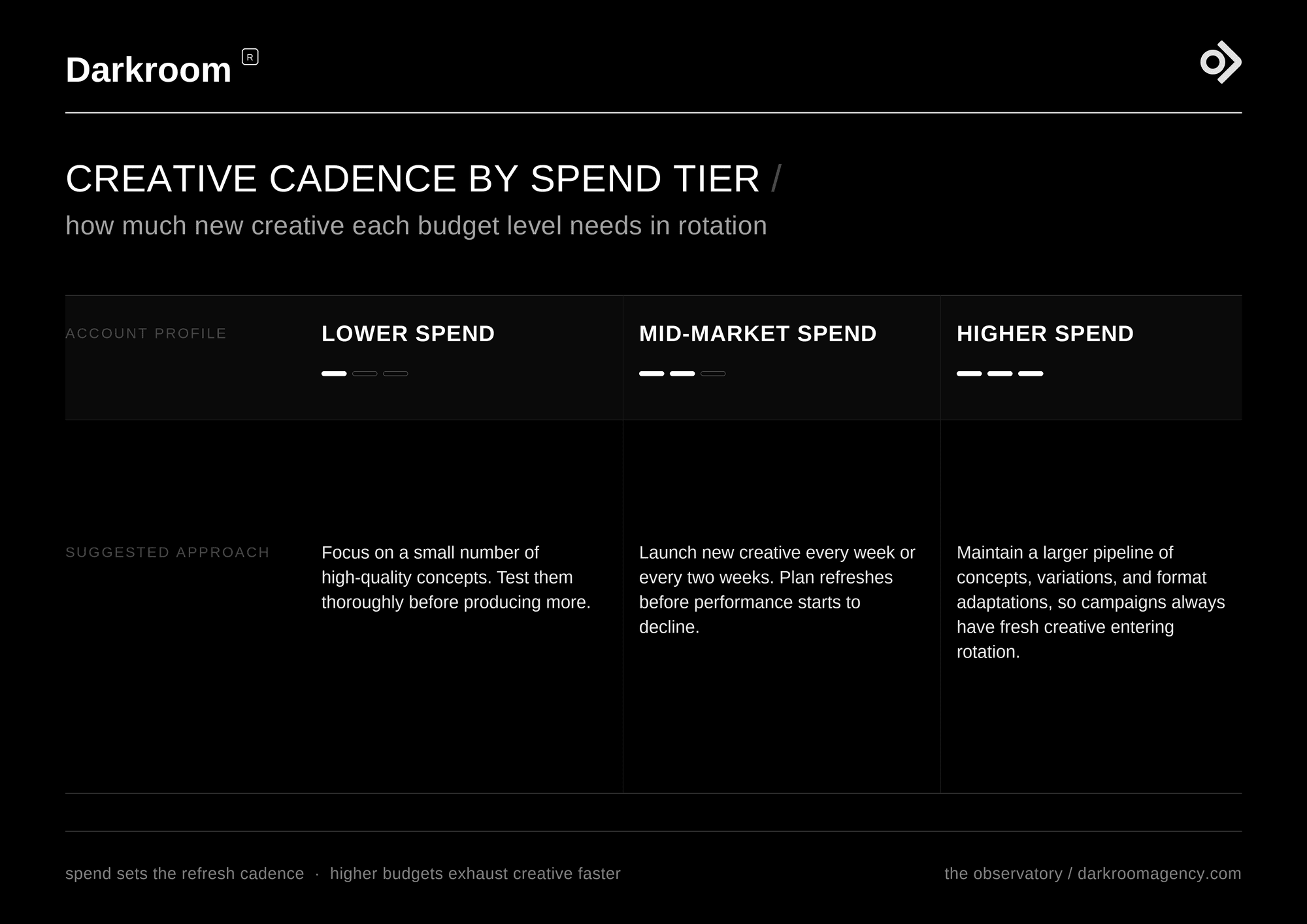
There isn't a universal target for creative volume. The right number depends on your budget, audience size, platform mix, and how quickly your creatives lose effectiveness.
A local business doesn't need the same production cadence as a brand investing six figures across multiple platforms. Matching someone else's output usually creates more work than value.
Meta's data in AppsFlyer's 2025 Report supports that point. Advantage+ Shopping Campaigns with at least 20 creatives recorded a 29% lower median incremental cost per purchase. Campaigns with more than 20 creatives also saw up to a 29% lower cost per acquisition (CPA).
Those findings don't mean every account needs 20 creatives. They apply to Advantage+ Shopping Campaigns, and the right volume still depends on your budget and account structure. The goal is simple: give platforms enough creative variety to test and optimize.
Here's a practical way to think about it:
Measurement Framework for Creative Volume
Creative volume only matters if you measure what happens before, during, and after each test. Too many teams focus on campaign performance and ignore how efficiently they produce and validate new creative.
A simple framework keeps those stages separate.
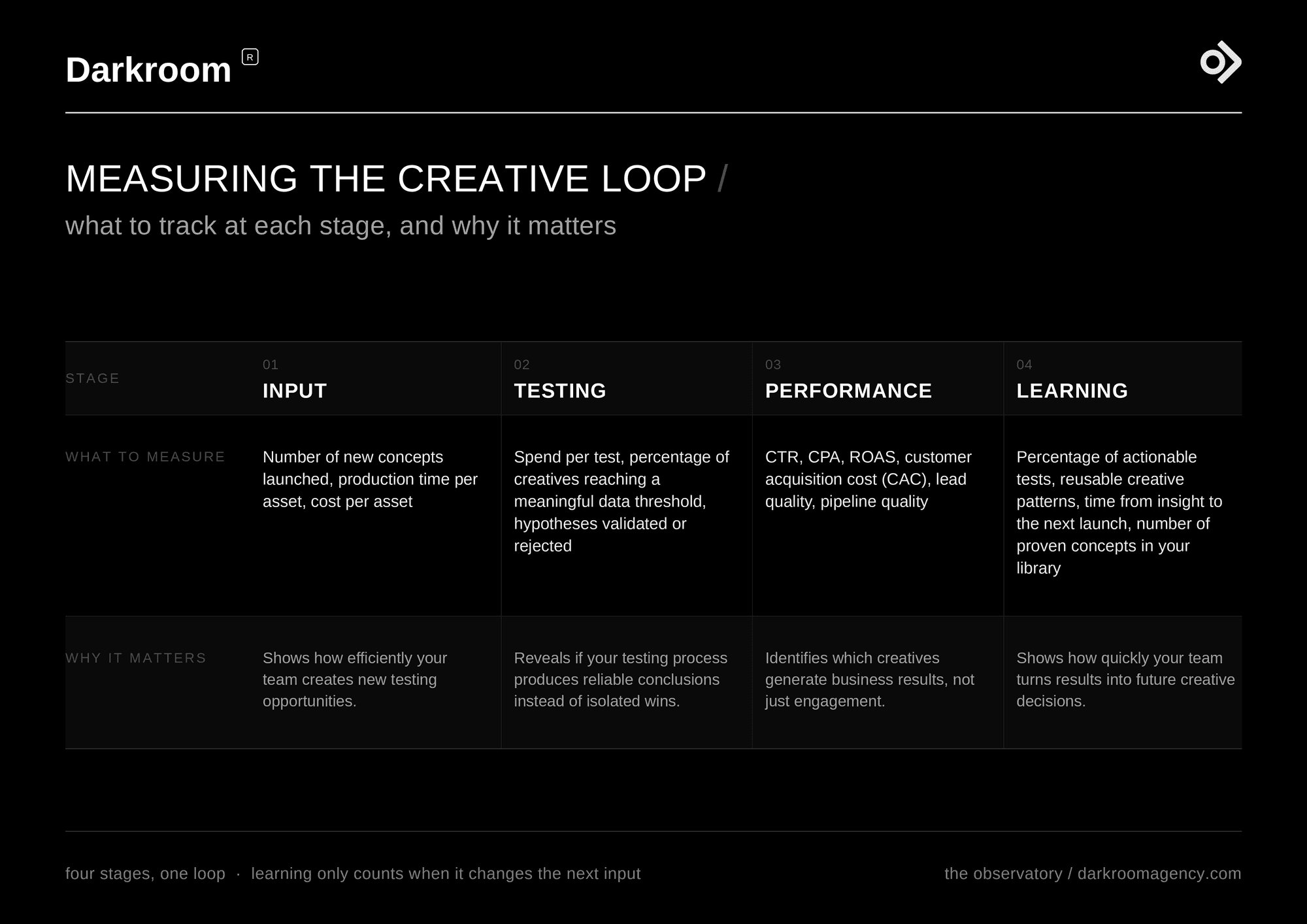
Most teams stop at performance metrics. Those numbers tell you which creatives won, but not why your team keeps finding new winners.
Learning metrics matter just as much. Every test should produce an insight, even if the creative underperforms. Those insights shape the next round of creative.
The framework works as a system. Input feeds testing. Testing informs performance. Learning improves the next round.
Bottom Line: Build a Creative System That Scales With Your Campaigns
Creative volume gives paid social platforms more opportunities to test winning messages before performance starts to decline.
The best teams treat creative volume as an operating rhythm. Testing, iteration, and creative refreshes become part of the workflow instead of a reaction to falling performance.
Build a process your team can sustain, measure what each test teaches you, and carry those insights into the next round of creative. Over time, that's what separates a steady creative system from a constant scramble to replace fatigued ads.
If creative volume has become difficult to sustain, Darkroom's performance creative team helps brands build the workflows, testing cadence, and creative operations needed to keep fresh creative flowing into market.
Frequently Asked Questions
How many creatives should I have per ad set?
There isn't a fixed number for every account. The right volume depends on your budget and testing cadence, but you should always have enough active creatives to replace fatigued ads before performance declines.
How many ad creatives do you really need per week?
Your production schedule should match the pace of your account. Lower-spend accounts may only need a few new creatives each month, while larger accounts usually benefit from weekly launches that keep testing and creative refreshes moving.
How do I know when a creative is fatigued?
Creative fatigue usually appears before results collapse. Rising frequency, lower CTR, declining thumbstop rate, and weaker conversion efficiency all suggest it's time to test fresh variations instead of relying on the same creative.
How do I increase creative volume with a small team or no agency?
Focus on systems before headcount. Reuse winning concepts across formats, build modular creatives, keep a library of proven hooks, and use AI for repetitive production tasks. Those changes usually create more testing opportunities without adding more people.
Does more creative volume actually help the Meta and TikTok algorithms?
More creative helps when each variation tests a meaningful difference. Platforms perform better when they have multiple messages, formats, and creative angles to evaluate. Publishing large numbers of nearly identical ads rarely produces the same benefit.