GROWTH MARKETING
What an Enterprise Marketing Agency Should Commit To at $100M+




Written by Darkroom leardership
Time to read: 10 minutes
Last update: August 17, 2026

An enterprise marketing agency manages media, creative, and retention for companies with in-house marketing teams. At a revenue level of over $100 million, the difference between it and a mid-market agency is not one of capability but rather of operating model: it has senior owners with names, the finance department will accept the measurements, and there is a guaranteed amount of creative work.
The failure of agency selection lies in the operating model, not in the pitches. All the agencies on your list could name the same channels. What distinguishes them is who will be assigned to the account after three months, what they will commit to measuring, how much work they will produce, and whether or not they will be able to work with the team you already have.
When there are three finalists, the total cost of the process is about $1 million among all the parties, increasing to around $1.2 million if an incumbent is included (ANA, 4As and Advertiser Perceptions, The Cost of the Pitch, July 2023, updated by The Cost of the Pitch II, June 2024).
The relationship currently in place has an average duration of about 7 years, which is double the 3.2 years recorded in 2016; however, relationships involving only the media last much less, at 3.7 years (ANA and 4As, Client-Agency AOR Relationship Tenure, April 2025). If you are holding the appointment specifically for media purposes, you should plan for the shorter figure.
If you're still in the process of shortlisting, then look at how to select a growth marketing agency. If you're buying a service for a consumer brand, not a business-to-business one, go to the section that compares the two types of engagement, since they differ most in reporting frequency.
What constitutes an enterprise marketing agency and in what way does it differ from a mid-market one?
An enterprise marketing agency is meant to function alongside an existing internal marketing team, not in place of it; this single structural point underlies all other differences and defines when to use an enterprise marketing agency when reviewing the situation.
At this level, there are three changes: since the client already has in-house capabilities, the agency provides extra capacity and specialist knowledge rather than taking on the role of the marketing department; furthermore, the agency inherits a measurement system that it did not create and which it cannot replace, so it has to demonstrate its incremental value within that other organization's data model.
The third change concerns governance; instead of going through a single founder, approvals now have to pass through the legal, finance, and brand departments, which means that speed depends on how the process is designed rather than on the amount of effort put in.
In the case of mid-market engagements, all three aspects are reversed: the agency is usually the marketing team, it sets up the measurement stack on its own, and approval takes the form of a single meeting. A company that has only ever worked in this way will be able to describe enterprise digital marketing services accurately but will still have difficulty in delivering them, since the constraint under which it has never operated is other people's calendars.
Enterprise marketing also covers a wider range of channels: paid media, performance creative, retention, marketplace and retail media, and increasingly AI search. An enterprise digital marketing agency ought to treat these as part of a single strategy rather than as separate parallel activities. For a comparison of firms rather than commitments, refer to our list of ecommerce specialists.
Who is actually working on your account, and how senior are they?
The ones who give the pitch are frequently not the ones who end up carrying out the work. The only effective defense is to include the owners' names in the statement of work: ask for their names, titles, and the amount of time they will commit in writing, and find out what arrangement is made if one of them leaves.
Darkroom employs a senior full-stack marketer who is responsible for your growth strategy, results measurement, and financial planning for both the Amazon and direct-to-consumer channels. As our service page makes clear, this individual is not regarded as a coordinator; instead, they are responsible for the strategy, carry out the analysis, and oversee the forecast rather than just passing it on.
Senior growth strategist | Growth plan, forecast, budget allocation, and financial pacing | Weekly diagnostic, monthly pacing review, quarterly reset | Named successor introduced before transition, two-week overlap. Name this person in the statement of work. |
Channel specialists | Execution in paid media, retention, marketplace, or creative | Weekly working sessions | Replaced within the discipline. The plan holds because the strategist owns it. |
Performance creative team | Concepting, production and iteration against the testing roadmap | Every two-week production cycle | Output cadence is contractual, so the commitment survives the individual. |
Analytics and measurement | Media mix modeling, incrementality design, reporting into your metrics | Monthly readout, quarterly model refresh | Model documentation transfers with the account. Ask whether it will. |
The importance of the escalation procedure is just as great as that of the roster. Before you agree, you should know whom to contact if a forecast turns out to be off by 20 percent and how quickly that call will be returned. If an agency cannot answer in a sentence, then it has not given the matter any thought.
What kind of commitments should an enterprise marketing agency make about measurements?
A company ought to adopt a cadence, a model, and a metric that your CFO is already using, and be prepared to be assessed on a test it might fail; anything less substantial amounts to reporting, not to measurement.
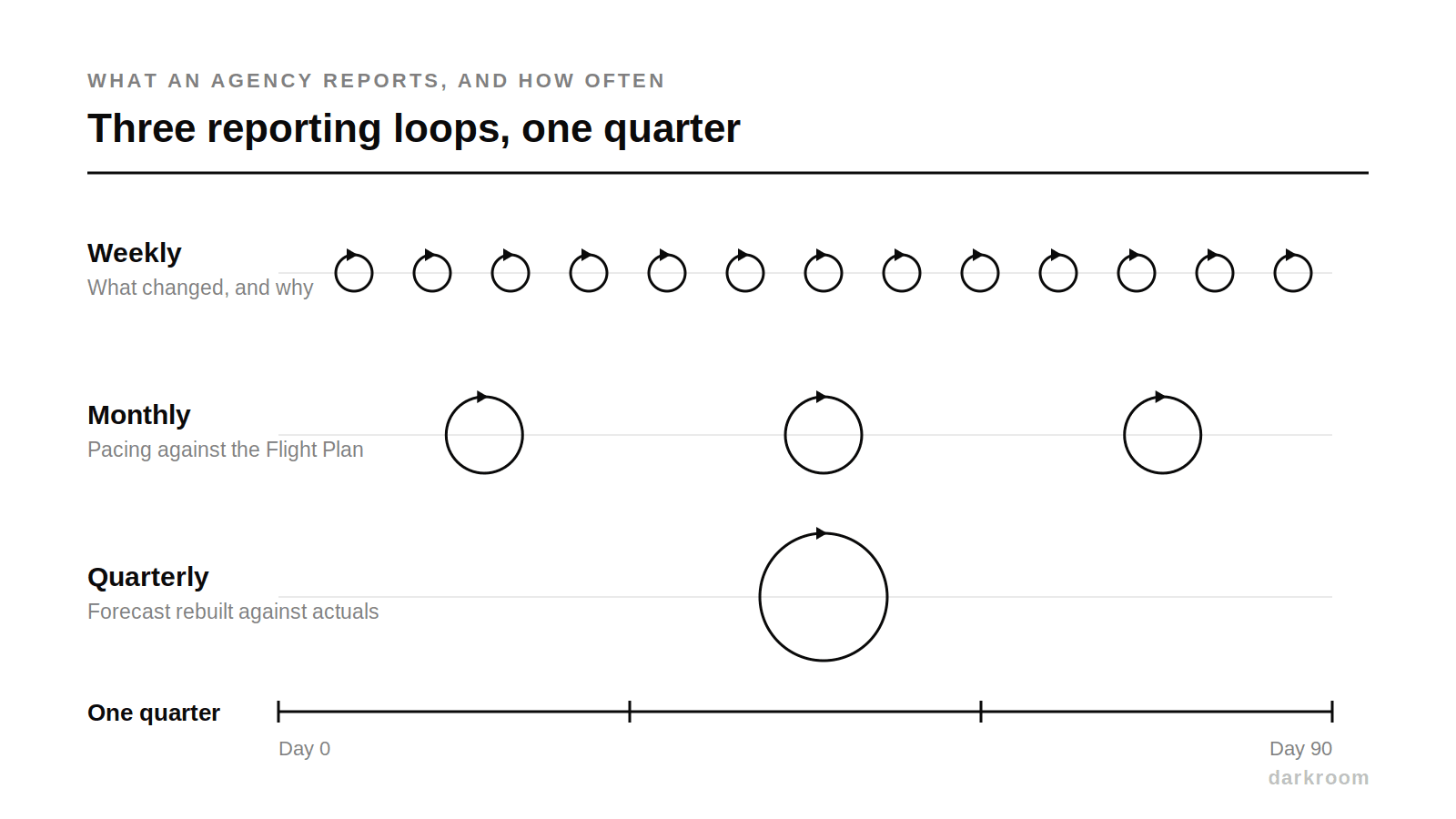
Darkroom has three levels of cadence. While weekly diagnostics explain what has changed and why, they do not state what actually occurred. During monthly pacing reviews, performance is assessed against the Flight Plan, a framework that integrates business objectives, profit and loss, media investment, daily pacing, and channel reporting. Once every quarter, the forecast is rebuilt based on actual results rather than the original assumptions.
The model is underneath there. Media mix modeling and root-cause analysis are carried out in Shadow, our measurement platform, and budgets are then allocated to the channels the model identifies as driving incremental revenue.
Where the model is uncertain, incrementality testing settles it, and geo experimentation is our default because it produces a result an agency cannot quietly grade itself on.
Reporting is based on two metrics which finance is already familiar with: the marketing efficiency ratio and the contribution margin. The platform's return on ad spend is not a commitment to measure it; it is merely the vendor assessing its own work, something that all agencies are aware of.
One commitment separates agencies more than any other: whether measurement is predictive rather than backward-looking. Attribution explains last month. A model that forecasts next quarter and is corrected against actuals makes budget decisions defensible in advance, and it is the clearest signal of an AI-native operating model.
Take that route towards Laundry Sauce, since it achieved a 290% increase in net revenue on Amazon, saw its repeat order rate rise by 23%, and gained 100,000 customers over 17 months.
What level of creativity should the agency promise and how frequently?
Creative volume is a contractual figure, not a goal. If an agency fails to specify a minimum in its statement of work, it is giving you a clue about the situation in month four, and enterprise advertising programs more frequently fail to maintain their output than to launch the first campaign.
Every two weeks, Darkroom aims to deliver between 250 and 600 production-ready assets, including user-generated content, static content, motion content, AI-generated ads, and high-production edits. The scope is just as important as the number since, on a cycle basis, every two weeks, the assets delivered are production-ready rather than just conceptual.
Volume is not output for its own sake. It is testing rate. More variants per cycle mean more hypotheses are resolved per quarter, which is why volume and performance move together rather than trade off.
For OLIPOP, the system enabled the brand to launch its first nationwide media campaign following its Series A funding, resulting in 3x revenue growth from the campaign and a 28 percent increase in reach among new audiences on connected TV, YouTube pre-roll, and Meta.
The structural requirement is a creative system rather than a campaign: a standing pipeline with a testing roadmap attached, not a burst of assets at launch. It also has to move at your tempo.
For Crate & Barrel we created launch experiences for 12 collections, with the entire process from briefing to launch taking as little as 14 days, and the first of these led to a 122% increase in new collection web traffic as a result of media coverage.
What kind of scope does an enterprise SEO agency have at this size?
It is the constraints, not the tactics, that determine the scope of Enterprise SEO. Although the tactics are well known, what changes when scaling is the fact that each recommendation must wait until another person's release cycle, template system, and governance process have approved it before it can appear on a page.
The work is governed by three constraints; since changes are made at the template level for thousands of URLs, any single decision has site-wide implications and must therefore be modeled before it is released.
Technical work also ends up in an engineering backlog that is the responsibility of a different team, so an enterprise SEO agency has to write the tickets and argue for priority rather than carrying out the work. Moreover, once customer-facing content has passed both brand and legal reviews, real publishing speed is achieved, regardless of how quickly the content team produces it.
The way the best enterprise SEO agency should be chosen for your situation will depend on which of those three constraints is most binding at your company; if the limitation is engineering capacity, then you should hire people with technical seniority, and if the issue is governance, then you should hire people who have experience in getting things through regulated approval chains.
Instead of looking at commitments, should we compare the named firms? Our list of SEO agencies operating at this scale provides the answer to that question.
Is it possible for the new agency to work in conjunction with the one that you currently have?
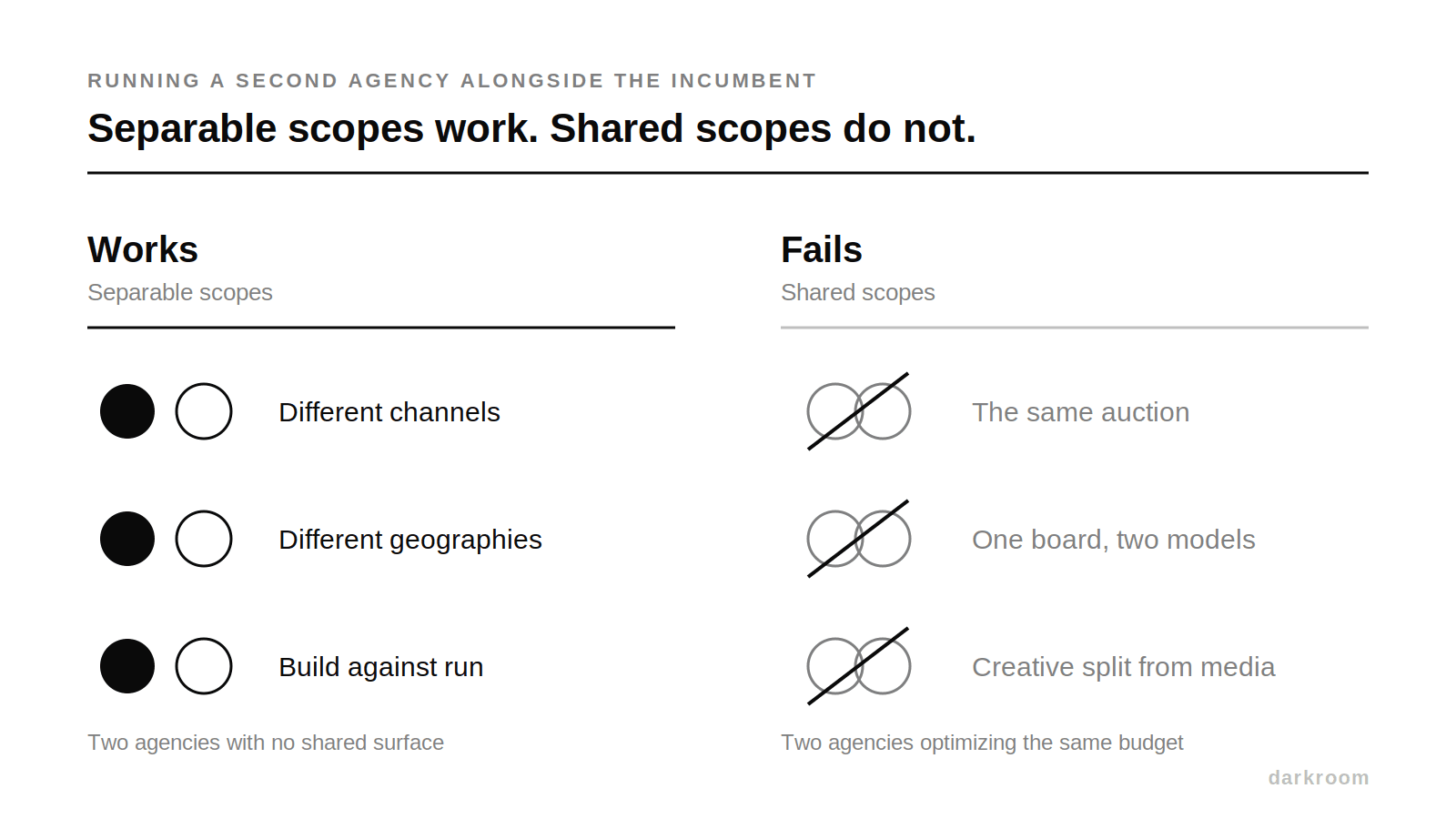
In favor of separable scopes and against shared ones: the criterion is whether the two agencies would be optimizing the same budget; all the other points then follow from that test.
At this level, coexistence is the rule rather than the exception. The number of ANA member marketers who run their own in-house agencies has increased from 42% in 2008 to 82% currently, and 92% continue to use external agencies in addition (ANA, 2023). If an agency says that it needs the entire account, then it is providing mid-market engagement.
Three methods prove to be reliable: having separate scopes for channels, with one agency responsible for paid social media and another agency in charge of enterprise e-commerce managing the marketplace; separating scopes by geography, so that each partner has its own distinct markets; and split arrangements between building and running, in which one team develops a capability and a different team operates it.
Three of them work reliably. When two agencies take part in the same auction, your budget ends up being drawn into a bidding battle with yourself. If two different measurement models report to the same board, a quarter of the money will have to be spent sorting out the figures rather than taking action. And if the creative team is separated from the media team, which carries out the work, the feedback loop that makes testing worthwhile is destroyed.
Darkroom functions within the client's governance structure rather than outside it. In the case of Cantor Fitzgerald, we redeveloped the digital platform together with the client's internal compliance and development teams, achieving 40% faster load times and a 25% longer session duration without changing the institutional requirements.
If the capability is actually located in-house, then it should remain with the company, and people should be hired for the areas that are missing. Among the ANA members who operate both models, the in-house team is already responsible for 61% of the work.
What do the first 120 days look like?
Media first, retention second. The sequence is deliberate rather than commercial: the behavioral data the model needs is generated by media, and retention based on a cohort that has not yet been acquired is merely guesswork presented as a strategy.
Based on our experience, the majority of agency relationships fail within the first 90 days because there is no agreement on what should be visible and by when. However, a clear sequence, included in the agency's RFP before it was signed, eliminates the dispute. Included in the agency RFP before signature, removes the argument.
Diagnostic and baseline | 0 to 30 | Account audit, measurement baseline, creative teardown, first production cycle briefed | A documented baseline and a named list of your largest revenue gaps |
Model and forecast | 30 to 60 | Media mix model built, Flight Plan live, first full asset cycle shipped | A forecast tied to profit and loss, plus first creative test reads |
Operate and pace | 60 to 90 | Weekly diagnostics running, budget reallocating against the model, retention diagnostic delivered | Pacing against forecast rather than last year; lifecycle automations live within 30 days of retention kickoff |
Compound | 90 to 120 | Quarterly reset against actuals, incrementality test designed, retention flows optimizing | Channel effects estimated rather than assumed, and repeat purchase moving |
Each phase is entitled to some degree of responsibility, and in our experience the most frequent reason for a missed onboarding is not due to the agency's capacity but rather a delay on the client's part, this being either access to the data, the signing off of the margin, or a single unnamed budget approver.
For the first phase, access to data and historical spending data are required. In the second phase, the finance department must agree on the margin inputs. For the third phase, one person must agree to the budget changes. In the fourth phase, it is necessary to have the discipline to leave a test running.
Retention pays once the cohort exists, which is the argument for sequencing it second. For Drip Hydration, the published outcome is a 42% year-on-year increase in conversion rate and a 15% year-on-year increase in return on ad spend.
For the same brand, our retention program reports an 85% increase in customer lifetime value within six months, together with 50% revenue growth over one year. As a Klaviyo Elite Partner, Darkroom conducts lifecycle work, including a diagnostic in the first week and monthly reviews based on a rolling 30-day roadmap.
What is the difference between an engagement of a B2C marketing agency and one with a B2B agency?
The reason lies in the length of the feedback loop, not in the tactics employed. With a business-to-consumer (B2C) engagement, a creative test can be evaluated within days; in the case of a business-to-business (B2B) engagement, the pipeline is assessed over quarters, and each commitment has to be adjusted to fit the length of that loop.
A B2C marketing agency should therefore aim for a high volume and a regular schedule since the loop is short and, as a result, iteration can have a compounding effect; insisting on a quarterly reporting schedule would spoil the category's only structural advantage.
Creative volume | High volume per cycle, short test windows | Fewer, larger bets with longer creative lifespans |
Reporting cadence | Weekly diagnostics, monthly reallocation | Monthly diagnostics, quarterly reallocation |
Primary metric | Contribution margin and repeat purchase rate | Pipeline value and stage conversion |
Time to a trustworthy read | Two to four weeks on creative, 30 to 60 days on media | One to two sales cycles, often a full quarter |
Who signs off | Growth or ecommerce lead | Marketing and sales leadership together |
Getting a B2C agency to handle the B2B situation, or the other way around, results in a mismatch between the reporting schedule and the sales cycle. When a B2C agency provides reports quarterly, it is not being careful; it is just being slow. The commitment should align with the sales cycle, and the reporting frequency should be included in the contract rather than agreed to in the second month.
Work with an enterprise marketing agency that publishes its commitments
Darkroom is an enterprise marketing agency based in Los Angeles and New York that works with consumer, commerce, and enterprise brands. The following three points are going to be written down:
A named senior full-stack marketer who owns your plan, forecast, and financial pacing, not a coordinator
250 to 600 production-ready assets per cycle, every two weeks
Weekly diagnostics, monthly pacing against the Flight Plan, quarterly resets against actuals, reported in marketing efficiency ratio and contribution margin.
Here's how the model operates: the Darkroom growth strategy.