PAID MEDIA
Instacart Ads: The 2026 Guide To Better Campaigns




Written by Darkroom leardership
10 min read
October 9, 2026

Instacart Ads is Instacart's retail media network, designed to help CPG brands connect with grocery shoppers in a variety of places. Brands can reach customers not just on the Instacart Marketplace, but also on retailer websites that use Carrot Ads and even on Caper Cart screens right in the store. Everything runs through a single, self-serve Ads Manager account.
Many Instacart Ads accounts end up losing money because of small details that are easy to overlook. For example, products might not be eligible to serve, bids may be set too low to win, keywords can go unchecked for weeks, and budgets sometimes run out before lunchtime.
Ads Manager has seen a lot of changes this year, including new campaign objectives, updated targeting options, and fresh ad formats. This guide is here to help brands navigate the marketplace, understand what types of ads are available, find their way around the interface, and follow an eight-step routine to boost results. It also covers the bigger-picture strategies that can make a real difference.
Key takeaways
Distribution sets your reach: Instacart Ads only serve where a retailer lists your product and has it in stock, so fix coverage before you raise bids.
Start with sponsored products: they're priced per click and built for sales; add display, shoppable video, and promotions once search pays back.
Build campaigns in Ads Manager's order: objective, Scope, format, budget and bidding, then ad groups and keywords.
Improve weekly with Instacart's own tools: the Recommendations page, the budget tab, bid strength, bid landscapes, and the keyword table cover most fixes.
Judge on growth, then prove it: read new-to-brand sales and share of digital shelf, and run a holdout test before you scale.
How does the Instacart marketplace connect brands, retailers, and shoppers?
Instacart connects shoppers with retailers that already carry your products. This means your ads only show up where your items are actually in stock and available for purchase. While your brand handles advertising on Instacart, the retailer completes the sale.
With over 1,400 retailers on the Instacart Marketplace, shoppers have plenty of options, and each order is handpicked from store shelves. For advertisers, there are a few key things to keep in mind:
Reach follows distribution: a product stocked by three regional grocers can only be advertised to their customers.
UPC matches your catalog: in Ads Manager, you add products by name, brand, or UPC, and a product missing images for every retailer won't serve at all.
Ads travel beyond the app: the same campaigns can run on Instacart Marketplace, on partner grocery sites, and on smart carts in-store.
These partner sites use Carrot Ads, which is Instacart's advertising technology designed for retailers. Over 310 partners are already on board, and the network keeps growing, with Gopuff and BevMo joining in September 2026.
Instacart's advertising and other revenue hit $297 million in Q2 2026, up 16% from the previous year. This growth even outpaced the company's 14% rise in gross transaction value for the same period.
Which Instacart ad formats can you run in 2026?
Sponsored products drive sales, display and shoppable formats drive discovery, inspiration ads and video drive reach, Caper Cart ads work in-store, and promotions change the price. Each format below covers where it shows, how it's bought, and what it's best for.
Sponsored products
Sponsored products show on the homepage, in search results, aisles, departments, and Buy It Again. They bid per click in a second-price auction.
Start here. They reach shoppers already looking for your category, which makes them the fastest route to sales.
Display ads
Instacart display ads run in storefronts, departments, and aisles. They buy on CPM in a first-price auction and link to your brand Page, which makes them the awareness layer for a launch.
Your Instacart brand page is a shoppable destination with its own URL, so it also works as the landing page for paid social.
Shoppable display ads
Shoppable display ads sit in search results with an add-to-cart button, bought on CPM in a first-price auction. Since June 2026, a single shoppable ad can hold up to 40 products, which suits multi-product launches and bigger baskets.
Shoppable video
Shoppable video runs in search results and is set up as a campaign in Ads Manager. Its placement sets whether it delivers reach or engagement.
Inspiration ads and the Immersive Feed
Recipe Ads and Occasion Ads place your products inside meal and occasion content, away from the aisle. Instacart's Immersive Feed, launched on 22 June 2026, is a 9:16 feed of 5- to 30-second recipe videos, still in early pilot.
The same release reports that Q3 2025 Recipe Ads averaged 78% out-of-aisle impressions and 43% new-to-brand sales, and Occasion Ads 90% and 36%.
Caper Cart ads
In stores, Instacart Caper Carts carry your ads automatically. Since April 2025, shoppable display campaigns extend to Caper Cart screens only when the shopper is in the relevant aisle, and the item is in stock. Shoppers spend more than 30 minutes with a cart on average.
Brand promotions
Brand promotions are brand-funded discounts shown on product item cards. They change the price a shopper pays, so they suit trial and basket size.
Every format above is bought in one account, so Instacart advertising is easy to start. Add formats one at a time.

What does the Instacart Ads Manager interface look like?
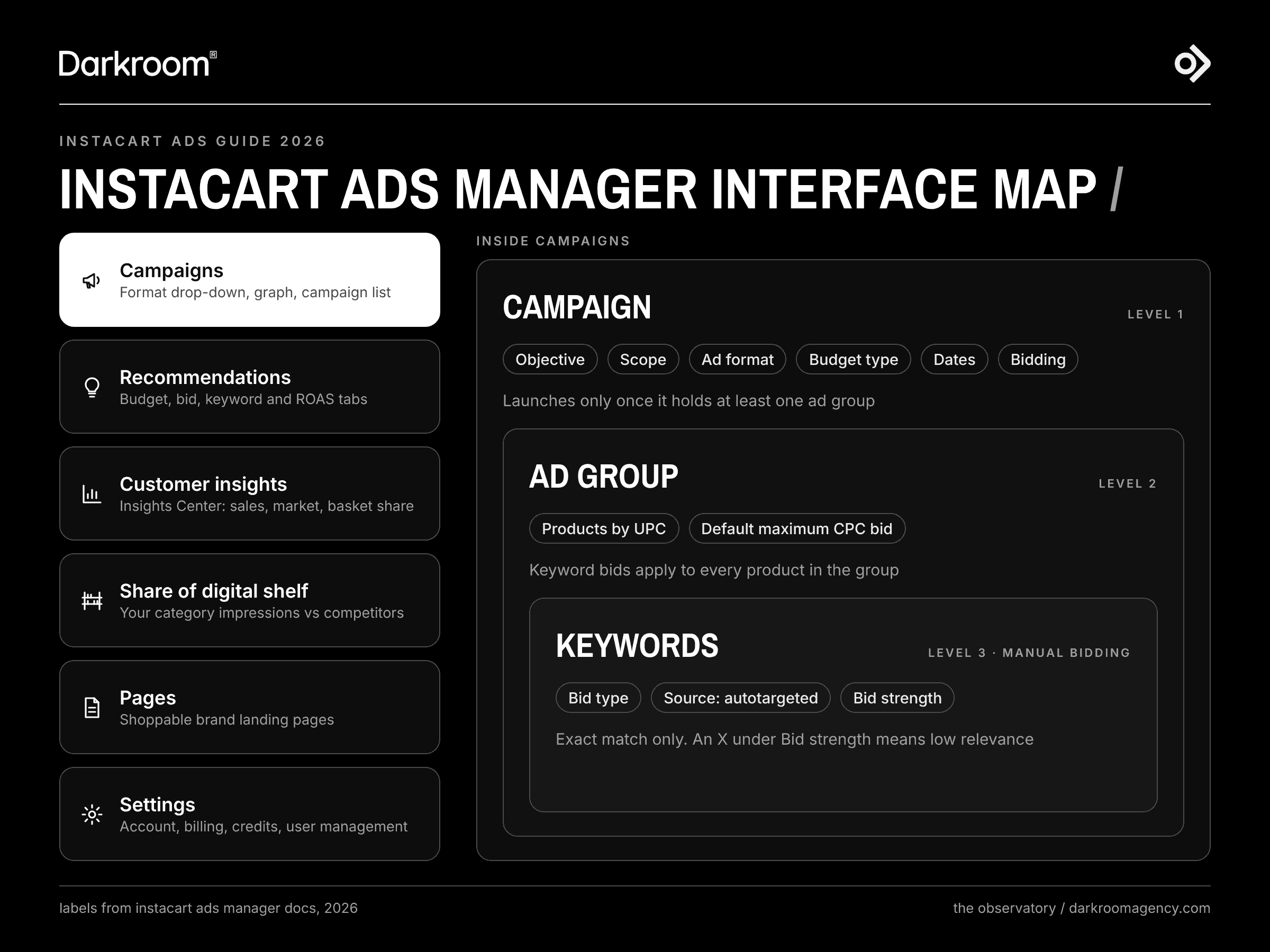
Ads Manager runs on a left-hand navigation that separates campaigns, recommendations, insights, and settings, and every campaign follows the same three levels: campaign, ad group, and keywords.
The left-hand navigation, screen by screen
Sign in at ads.instacart.com, the Instacart Ads login for brands and agencies. Each menu item does one job:
Campaigns: the megaphone icon. A drop-down switches between formats such as Sponsored product and display, and each view shows a performance graph above your campaign list.
Recommendations: budget, bid, keyword, and ROAS suggestions for your active campaigns.
Customer insights: the graph icon opens Insights Center, with Sales and market share, Customer and basket share, Saved reports, and Uploaded.
Share of digital shelf: your share of category impressions next to your closest competitors.
Pages: your brand's shoppable landing pages.
Settings: the gear icon holds Account, Two-factor authentication, Billing, Credits, OAuth, and User management.

Source: Instacart Docs
How campaigns, ad groups and keywords fit together
Every sponsored product campaign is built in three levels:
Campaign: the objective, Scope, ad format, budget, dates, and bidding settings.
Ad group: the products you advertise and their default maximum CPC bid.
Keywords: available with manual bidding, in a table that shows each keyword's bid type, source, and bid strength.
Keyword bids apply to every product in the ad group, so only group products that shoppers search for with the same words.
On the campaign list, a green dot marks an active campaign with enough budget and an orange dot marks one running short. That dot is the fastest health check in the account.
Users, roles and agency access
Every account can include up to five admins. Users are assigned as either Advertiser users or Agency users, each with a specific access level: Admin, Read-only, or Custom. This setup helps keep things organized and ensures everyone has the right permissions for their role.
Custom access sets None, Read, or Edit for each area, from Campaign Management to Payment Settings. An Instacart Ads agency also needs Agency Admin Access and the Agency Consent Terms, and it only sees Insights Center data once an admin grants it.
How do you set up a campaign in Instacart Ads Manager?
Create the campaign first, add at least one ad group, then set bids, because a campaign can't launch without an ad group. Instacart Ads Manager walks you through campaign creation in this order:
Create campaign: click Create campaign in the top-right corner and give it a descriptive name.
Campaign objective: pick from Reach, Engage, Maximize sales, Grow, Acquire, or Build your own. Sponsored product campaigns use Maximize sales or Build your own.
Scope: run across the Instacart Ads ecosystem, or pick one partner for partner-specific ads.
Campaign ad format: choose sponsored product.
Budget type: Daily budget or Lifetime budget. A lifetime budget only supports manual bidding.
Dates: campaigns go live on the start date, usually by noon PT. With no end date, a campaign runs until its budget is spent.
Bidding: Optimized, maximize sales (with a target ROAS), Optimized, boost new-to-brand, or Manual.
Ad group and products: add products one by one or paste UPCs in bulk. Once the ad group is finalized, you can pause products but never remove them.
Images: fix any Missing Product Images alert. Red means the product won't serve anywhere; yellow means it serves at only some retailers.
Bids and keywords: enter a Default maximum CPC bid. With manual bidding, add keywords one per line and set any keyword bids.

Source: Instacart
How do you improve Instacart Ads campaigns step by step?
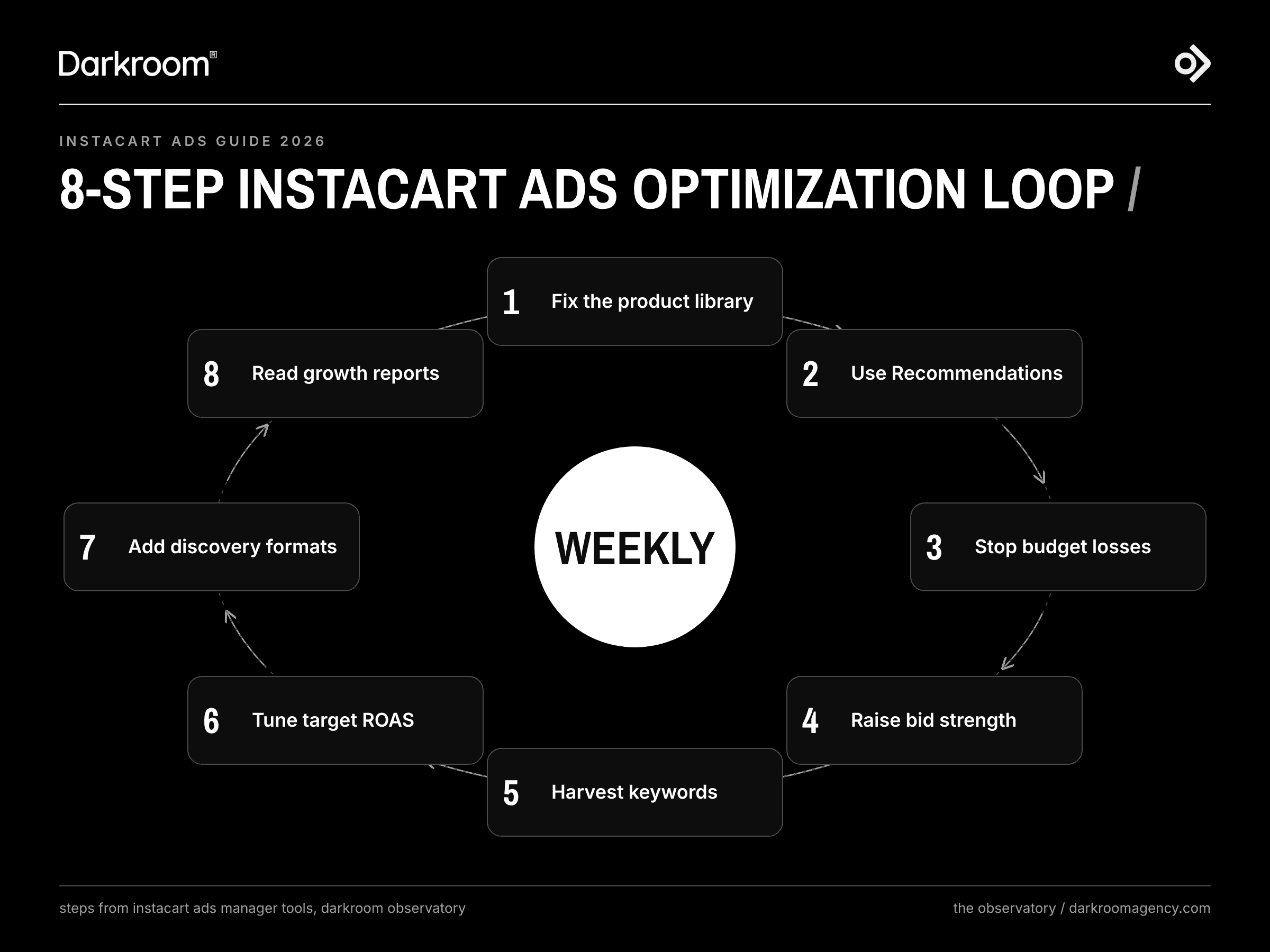
Work one weekly loop with tools already inside Ads Manager, in this order, starting with the products and ending with the reports.
Step 1: Fix the product library before you touch bids
Before adjusting bids, make sure every product is ready to sell. Start by clearing any red or yellow Missing Product Images alerts, since products without images are less likely to convert. Double-check that your UPCs are valid for each retailer you work with, as missing or incorrect codes can prevent listings from appearing.
Once your product data is in good shape, it is time to organize your campaigns. Group products that target the same search terms together in one ad group. If a product does not fit with the others, create a separate group for it. This approach helps keep your ads relevant and makes it easier to track performance by product type.
Step 2: Work the Recommendations page every week
Head over to the Recommendations page and take a look at the budget, bid, keyword, and ROAS tabs. Each campaign will show different suggestions, so it is a good idea to treat every recommendation as a potential lead worth checking out. Instacart does not guarantee results, but reviewing these tips regularly can help spot new opportunities or catch issues early.
Step 3: Stop losing auctions to budget
The Daily budget tab gives a quick snapshot of the last seven days, showing how many auctions were missed, along with estimates for missed impressions and sales due to budget limits. This makes it easy to spot if budget constraints are holding back campaign performance.
When a campaign delivers strong ROAS but still misses auctions, the first step should be to increase its budget. Adjusting the budget before making other changes helps capture more opportunities without disrupting what is already working.
Step 4: Raise bid strength where it pays
When bids are too low, ads often struggle to win placements. The Default maximum CPC bid tab is a helpful tool here, showing both Bid strength and a Suggested max bid for any ad groups that might be underperforming. This makes it easier to spot where a quick adjustment could make a real difference.
If an ad group has enough data, try opening View landscape. This feature gives a seven-day projection of impressions, clicks, sales, and spend at different bid levels. It is a great way to see how small changes could affect results before you make any adjustments. Suggestions can be explored or applied right from the Campaign overview page.

Source: Instacart
Step 5: Harvest and clean your keywords
When using manual bidding, the default bid will automatically target keywords that seem relevant. Once a keyword gets its first click, it shows up in the keyword table with the source listed as autotargeted. This helps you track which keywords the system picks up, even before you make any adjustments.
It’s a good idea to move well-performing keywords into their own keyword bids. If a keyword is marked with an X under Bid strength, it usually means it isn’t very relevant to the ad group and probably won’t win many auctions.
Keep in mind that keywords are exact match only. For example, if you add "ice cream" as a keyword, it won’t automatically match searches for "ice creams" or other similar terms. To make sure you’re covering all the ways people might search, add plurals and common variations manually.
Step 6: Tune target ROAS on optimized campaigns
Target ROAS acts like the dial for how aggressively optimized bidding goes after results. If the target is set too high, expect to see spend, sales, and win rate drop off. On the other hand, lowering the target encourages the campaign to use more of its budget, which can help drive more conversions.
Each time you adjust the target, the campaign enters a new learning phase that usually lasts three to seven days. It is best to make changes gradually, in small steps, to avoid disrupting performance. As a rule of thumb, set the lowest target at your break-even ROAS to protect your margins.
Step 7: Add discovery formats once search is profitable
Once sponsored products start delivering a positive return, it is a good idea to add in selected audience shoppable display and shoppable video campaigns. If the Immersive Feed pilot is available, that can be included as well. All of these should direct traffic to your brand Page, so shoppers have a single place to explore your full offering.
When setting display bids, use your product margin to determine the maximum cost per thousand impressions that makes sense for your business. This helps ensure your campaigns remain profitable while reaching the right audience.
Step 8: Read the reports that show real growth
Attributed sales tell you what ads touched. Three reports tell you whether your brand grew:
▪ New-to-brand sales %: the share of sales from shoppers who haven't bought your brand in the last 26 weeks.
▪ Market share: Insights Center shows sales and share by category, down to UPC level.
▪ Share of digital shelf: your share of paid and organic category impressions, next to up to four blinded competitors. Changes can take a few days to a few weeks to show.
Export daily data as a CSV each month, so you can line Instacart up against your other networks.
How are Instacart promotions different from ads?
Ads pay for placement; Instacart promotions change the price the shopper pays.
Instacart ads | Instacart promotions | |
|---|---|---|
What you pay for | Clicks or impressions | A discount you fund |
Where it shows | Search, browse, video, carts | The product item card |
What it changes | Visibility | The price at checkout |
Where the cost lands | Media budget | Margin, above the contribution line |
Brand promotions are organized in promotion groups, and offers include coupons, Stock Up and Save, gifts, and BOGO. Since September 2026, a promotion group can target regions or store groups. Retailer promotions are a separate, retailer-run tool that became generally available in July 2026.
Attach a promotion to the sponsored product campaign that covers the same SKUs, so the ad's targeting carries the offer. In Instacart's analysis of promotions live from January to April 2023, Kodiak's baskets with a redeemed Stock Up and Save coupon were 2.2x bigger in dollar value than baskets without one. That comparison includes shoppers who chose to redeem, so read it as evidence of basket-building and test lift separately.
Read also: Contribution Margin for Marketing: How Finance Judges Your Budget
How do you know if Instacart Ads are really working?
Ads Manager shows the sales your ads were attributed to.
Attribution on Instacart is click-based: purchases within 14 days of a sponsored product click count as attributed sales. Delivery is audited: the Media Rating Council first accredited Instacart's metrics in March 2024 and continued it in June 2026 for sponsored product, display, shoppable display, and shoppable video ads, including Carrot Ads partner sites.
MRC accreditation proves your ads were served and seen. For that, Instacart runs lift tests with randomized exposed and holdout groups. Applegate measured a 35% sales lift in Q3 2022 and Reckitt 16.5% in Q3 to Q4 2022, and Instacart notes lift testing isn't available to every partner.
Run your own check too. A geo holdout test compares markets with and without your Instacart spend, and it measures every network on the same basis.
Where does Instacart fit next to Amazon Ads and Walmart Connect?
Instacart is the grocery layer of your retail media plan: smaller than Amazon or Walmart Connect, and the one network that reaches shoppers across hundreds of grocers with a single buy. The Q2 2026 numbers show the scale gap:
▪ Amazon: advertising services revenue of $19.8 billion, up 26%.
▪ Walmart Connect: US growth of 43%, excluding VIZIO, in the quarter ended 31 July 2026.
▪ Instacart: advertising and other revenue of $297 million, up 16%.
Size Instacart from your own sales. Take the share of your online grocery category sales that runs through Instacart's retailers and apply it to your monthly retail media budget. In a Darkroom model, illustrative only, a $300,000 monthly budget and a 12% share gives Instacart a $36,000 starting line.
Then plan the networks together, using the same measurement for Walmart Connect's full-funnel platform and Amazon. If you also need YouTube, Google, and Meta in that plan, our paid media team runs them alongside retail media.
Read also: Amazon vs Retail Media Networks: Where Brands Should Actually Spend in 2026
Which Instacart Ads best practices matter most for a CPG brand?
The strongest Instacart Ads programs are planned from the business outward: distribution, margin, and the grocery calendar decide where money goes before anyone sets a bid. These five practices sit above the weekly loop.

Give every dollar one job
Split your budget into three jobs and judge each on its own number:
▪ Defend: branded keywords keep shoppers already looking for you, judged on efficiency.
▪ Win the shelf: category keywords, judged on share of digital shelf.
▪ Acquire: the Acquire objective or new-to-brand optimized bidding, judged on new-to-brand sales.
One blended ROAS hides the spend that actually grows the brand. Branded search will always post the best return, and it quietly absorbs budget when nobody separates it.
Follow your distribution
Ads can only drive sales for products that are actually available, so it makes sense to align your media plan with your sales team's calendar. The Scope step is a great way to focus on one partner when timing is critical. If a retailer starts running low on stock, it's smart to pause or shift spend to avoid wasting clicks on products that shoppers can't buy.
If Instacart campaigns are managed separately from trade planning, ad budgets often end up being spent in areas where sales are already strong. Coordinating these efforts helps make sure that advertising supports growth where it is needed most, rather than doubling down on existing strengths.
Use promotions for trial and protect your hero SKUs
Discounts really pull their weight when they help bring in new customers or encourage shoppers to try something different, like a new product launch, a fresh flavor, or a different pack size. When it comes to a top-selling item that already moves well at full price, ongoing coupons usually just give a deal to people who were planning to buy anyway.
It helps to plan your promotions calendar around new products and big moments throughout the year, while keeping your regular items at full price. This way, discounts work where they matter most and your bestsellers keep delivering full value.
Plan creative around meals and occasions
Think about how most people shop for groceries. Sometimes it is for a quick dinner; other times it is for a big holiday or a fun game night with friends. Instacart recognized these different shopping moments and created formats like recipes, occasion-based content, and vertical videos to match.
With a single creative shoot, brands can now get a 9:16 recipe video, a shoppable display set, and a refreshed brand Page, all tailored to the same occasion.
Plan these key moments a quarter. That way, creative assets can be approved and ready to go before the season kicks off.
Treat Instacart data as research for the whole business
Insights Center gives a clear view of both customer share and basket share, making it easy to spot which categories shoppers are actually adding to their carts. With this information, it becomes much simpler to choose the right product bundles, plan cross-category promotions, or even identify partner brands that make sense for your audience.
Once you have these insights, the next step is to share them with retail buyers. Sell sheets in Ads Manager pull together your product sales, order counts, and per-store averages, all tailored for Instacart’s network of over 1,400 retailers who are always on the lookout for new products. This way, ad performance data becomes a powerful tool to support your case for wider distribution.
Run Instacart, Amazon and Walmart Connect as one retail media system
This approach works best when a single team manages campaigns across all networks. Consider how shoppers often buy from Amazon, Walmart, and Instacart in the same week. Each platform tracks its own returns, which can make it hard to see the full picture unless everything is coordinated.
Darkroom brings all these networks together into one retail media system. With a senior strategist focused on your P&L, every network gets measured for both incrementality and contribution profit. For example, when SAUZ, a pasta sauce brand available in nearly 7,000 stores, used this system, its Amazon sales velocity increased about 10x in just six months.
Book a call with our retail media team
Frequently asked questions
Who can advertise on Instacart?
Any brand whose products are sold by Instacart's retail partners can advertise on Instacart, from national CPG companies to emerging brands. Retailers can advertise too, through retailer promotions. Because ads only serve where an item is listed and in stock, your distribution across Instacart's retailers sets the ceiling on your reach.
Do Instacart Ads drive in-store sales?
Instacart's own Circana studies say they can. In studies published in January 2025, two CPG brands saw in-store sales lifts of 21% and 15% among shoppers exposed to sponsored product ads, and later display studies showed lifts of 11.8% and 5.6%. These are brand-selected case studies, so test your own brand before budgeting on them.
How long should an Instacart Ads test run?
Plan for a full quarter. Each bid or target change starts a 3 to 7-day learning phase, keywords need a few weeks of clicks before you can prune them, and a lift test needs enough orders in both groups to show a real difference. Judge the test at quarter end on incremental sales and contribution profit.
Can you run Instacart Ads outside Instacart?
Yes. Instacart's off-platform campaigns use its shopper data to target ads on other channels, with links back to Instacart to buy. Instacart has announced integrations with Google Shopping ads, YouTube, Roku and The Trade Desk, and says its off-platform reach covers streaming TV, web, social and search.
What is the difference between Instacart Ads and Instacart Carrot Ads?
Instacart Ads is where brands buy media. Instacart Carrot Ads is the ad technology retailers use to sell ads on their own sites and apps, launched in March 2022 and used by more than 310 partners in September 2026. Brands reach Carrot Ads sites through the same Ads Manager campaigns, or target one partner with the Scope step.